
5-Inch vs. 7-Inch FPV Drones: Key Differences and How to Choose
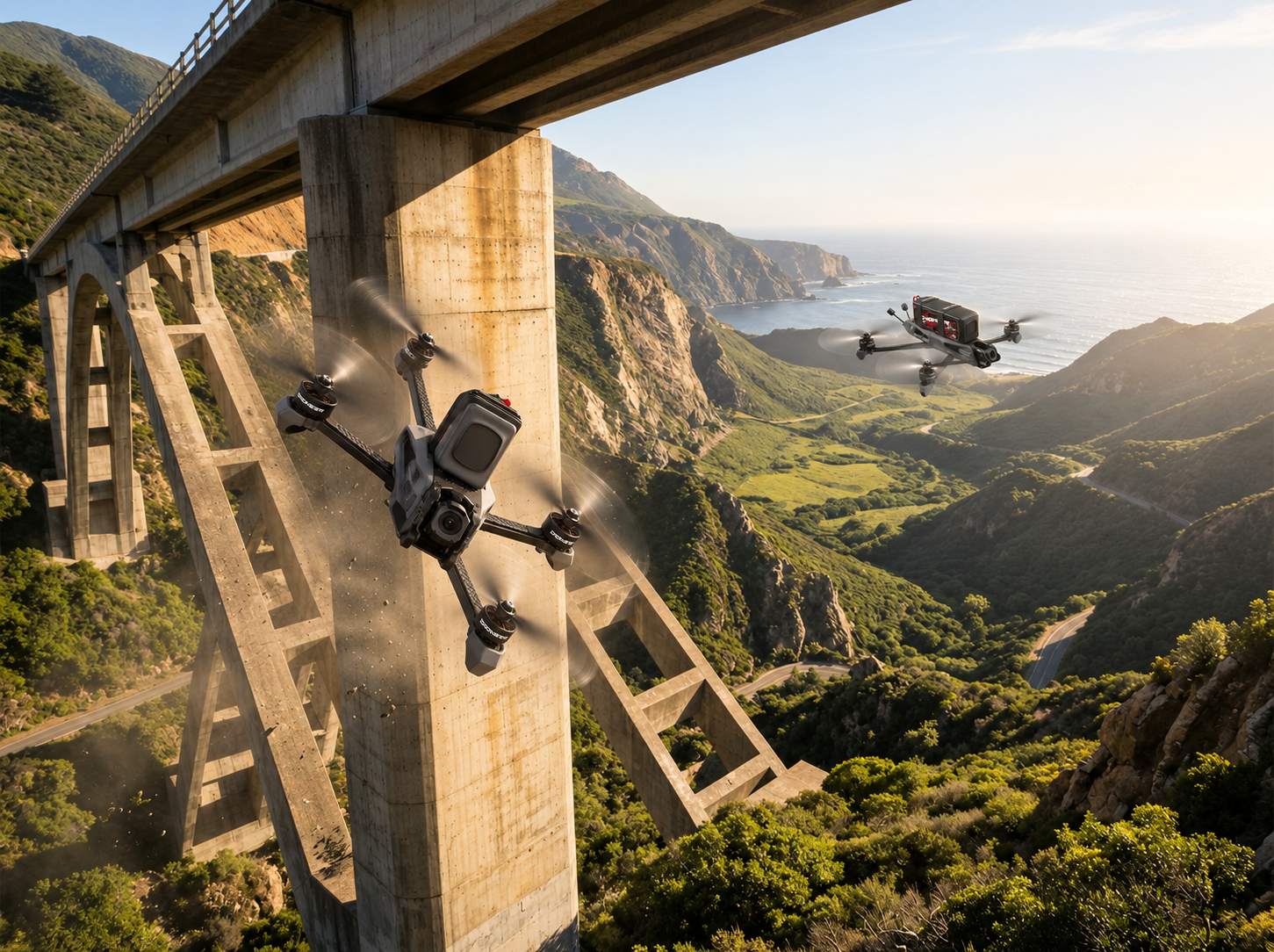
The world of remote-controlled flying has been revolutionized by First-Person View (FPV) drones, offering pilots a full, hands-on experience that standard camera drones simply can’t match. Whatever you want to do, whether it’s to explore far-off places, film high-speed cinematic footage, or pursue the thrill of acrobatic acrobatics, the most important choice you will make is choosing the correct drone size.
There are a few prop sizes available, but the community is dominated by two form factors: 5-inch and 7-inch FPV drones. Even a two-inch difference in propeller diameters results in very different flying dynamics, component requirements, battery performance and intended applications.
In this in-depth article we’ll dissect the main differences between 5-inch and 7-inch FPV platforms, outlining their pros, cons and performance indicators to help you decide which size is best suited to your style of flying.
What is a 5-inch FPV drone?
The 5 inch class is the best for FPV flying, everyone agrees. This size, between 210 and 250 mm from motor to motor, is the best compromise between durability, power, weight and agility.
A typical 5 inch fpv drone is powered by high-KV motors (2207 or 2306 size) and 4S or 6S LiPo batteries (1300mAh-1500mAh). With their high thrust-to-weight ratios , these quadcopters are very maneuverable and have a rapid throttle response .
Primary Applications:
Flying freestyle means flying flips, rolls, power loops and gap shots with extreme precision.
FPV Racing: You need to accelerate and take corners fast to make it through the high-speed tracks.
Close-range cinematic shots: when you need rapid response, such as chasing cars, participating in action sports, or mountain biking.
What is a 7 inch FPV drone?
Designed for stability, endurance and scale, the 7 inch quadcopter. It uses bigger propellers (7040/7042) which are powered by bigger, lower KV motors (such as 2806.5 or 2807), and the motor wheelbase is usually bigger than 300mm to 340mm.
The standard 7 inch fpv drone is built to carry heavy payloads over long distances, like full-sized action cameras, high-capacity Li-Ion battery packs or specialized telemetry equipment.
Main Applications:
Long-Range Exploration: Beyond the usual battery range limits to cross mountain ranges, valleys and coastal regions.
Cinematic Mountain Surfing: smooth, sweeping aerial coverage and low micro-vibrations.
Heavy payload carrying means carrying full HD/4K action cameras without trading off flight control or stability.
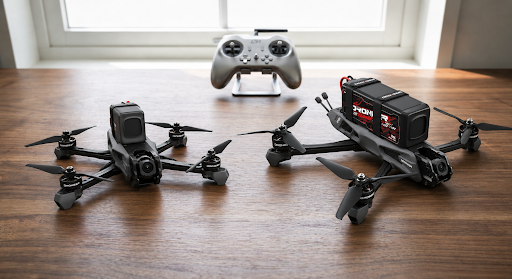
Performance Comparison in Detail
Simple Comparison Table
To get the full picture of what these two sizes look like we look at their key characteristics in five main categories:
| Characteristic / Measurement | 5-Inch FPV Racing Quadcopter | 7-Inch FPV Quads |
| Primary Specialty: | Proximity Flying, Racing and Freestyle | Long Range Cruising & Heavy-Lift Cinematography |
| Average Flight Duration | 3 – 6 minutes (High Intensity) | 10 – 30+ minutes (Cruise) |
| Battery Type | 4S-6S LiPo (1300-1500mAh) | 6S LiPo or Li-Ion Packs (3000-6000mAh) |
| Agility & Control | Fast reaction, high precision | Smooth, steady, heavier momentum |
| Wind Resistance | Weight to power ratio (good) | Superior (mass + prop momentum) |
| Repair & Durability | Cheap parts, very crash resistant | Bigger parts that are more prone to crash damage |
1. Flight Characteristics and Agility
The physical change in prop disk area changes the way these drones fly completely
5-Inch dynamics: With their lightweight chassis and aggressive prop pitch, 5-inch drones can pivot almost instantly. They can turn easily in tight spaces, bounce back from dives and snap into rolls. They have less rotational inertia , so it takes less effort to stop them in midair or to make abrupt corrections . This high responsiveness and low weight penalty allows pilots to perform lightning fast directional changes, aggressive freestyle tricks, and the precise micro-adjustments necessary for competitive drone racing or tight proximity flying around obstacles.
7-Inch Dynamics: The inertia of 7-inch drones is much larger. They don’t flip or stop quickly, but have some nice floaty cruise characteristics that are great for sweeping landscape shots. Hard acro maneuvers like sudden prop-washes or rapid rewinds can overload the motors and cause bad prop-wash oscillations. They are heavier and the pilots have to think ahead to their next move, so they fly more smoothly and cinematically, not like twitchy, high speed acrobatic snaps.
2. Range Limits and Time Limits on Flight
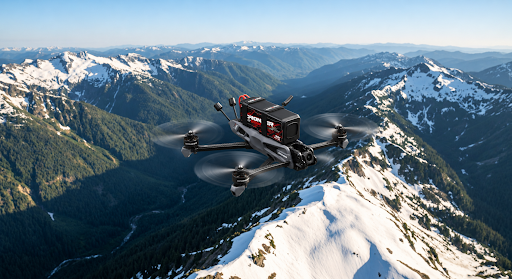
The 7-inch platform is very efficient in flight.
5-Inch Flight Time:
Built for power rather than staying power. A typical 5-inch quad on a 6S LiPo will give you between 3 and 6 minutes of active flight time. It is rare to make it eight minutes even when cruising slowly.
7-Inch Flight Time:
Designed to deliver. The 7-inch setup equipped with high-capacity 6S Lithium-Ion (Li-Ion) battery packs can fly effortlessly for 15 to 30 minutes on a single charge. The added endurance allows pilots to safely fly several kilometers out and back with additional battery life.
3. Robustness and Crash Recovery
Crashes are part and parcel of flying FPV. Your quad’s size really factors into how it reacts to impact.
5-Inch Durability: 5-inch drones have a small mass and a compact carbon-fiber frame shape and they absorb strong blows amazingly well. When you cartwheel across pavement or run into tree branches, all that happens is a broken plastic prop. Parts are cheap and easy to change. Parts are readily available.
7-Inch Durability: Because the frame, motors and larger battery are overall heavier, a 7-inch drone has a lot more kinetic energy in a crash. A collision at high altitude can destroy electronics stacks, bend motor shafts or snap thick carbon arms. That’s why 7-inch builds require careful piloting and reliable fail-safe options (such as GPS Return-to-Home).
4. Flight control and adjustment
5-Inch Tuning:
Betaflight tuning is not too hard for a 5 inch quad. Most flight controller standard PID profiles work well right out of the box and only require a few tweaks to eliminate vibrations.
Tuning 7-Inch:
A 7 inch size can be harder to tune a drone with. Larger propellers produce strong low-frequency vibrations and mid-throttle resonances. To achieve battery smooth footage, pilots need to tune their PID controllers, run specialized software filters like iNav or Betaflight, and have a clean camera setup.
How to Choose: Which Size is Right For You?
If you want a 5-Inch FPV Drone:
- If you are a beginner or intermediate pilot, it is the typical platform to study pilot mechanics without incurring high repair costs.
- Want to fly freestyle or race If you want to fly in tight spaces, do acrobatic maneuvers or dive buildings.
- You can fly in small to medium sized spaces like local parks, sports grounds or abandoned buildings (often referred to as “bands sites”).
- You want low-cost maintenance Cheap and easy to find propellers and parts.
Choose a 7-Inch FPV Drone if You:
- Long Range Exploration Is Your Thing You want to explore distant terrain, mountains or long coastlines, kilometers away.
- You Need Cinematic Smoothness: You’re shooting wide sweeping shots where steady cruising stability is more important than quick tricks.
- You Want 15+ Minutes of Flight Time: You want long endurance and not have to land all the time to change out batteries.
- You fly in high wind environments: The added mass and prop surface area help keep the drone stable in gusty outdoor conditions.
Final Thought
One platform isn’t “better” than the other, they are just different and serve different purposes in the growing FPV ecosystem.
The 5-inch FPV drone is a nimble, rugged pocket-rocket designed for freestyle adrenaline, tight maneuvers, quick repairs and everyday practice. It’s the perfect training ground for building pilot muscle memory and learning complex flight dynamics without a high cost to lose. On the flip side, a 7-inch FPV drone is a long-range specialized cruiser designed specifically for stability, heavy payloads, long flight times and surfing far-off mountains.
If you are choosing between the two, consider your local flying environments, maintenance budget and flying goals in general. If you are a beginner, like to fly at your local parks or enjoy doing acrobatic freestyle tricks, a 5-inch build is the most practical place to start. But if you want to capture cinematic landscapes, explore remote mountain ranges, or fly long distances without constantly swapping out batteries, then you’ll want to invest in a 7-inch platform for the endurance and stability you’re looking for.