
5 Essential Steps to Take When Your Fire Alarm Fails (And How The Fast Fire Watch Company Helps)
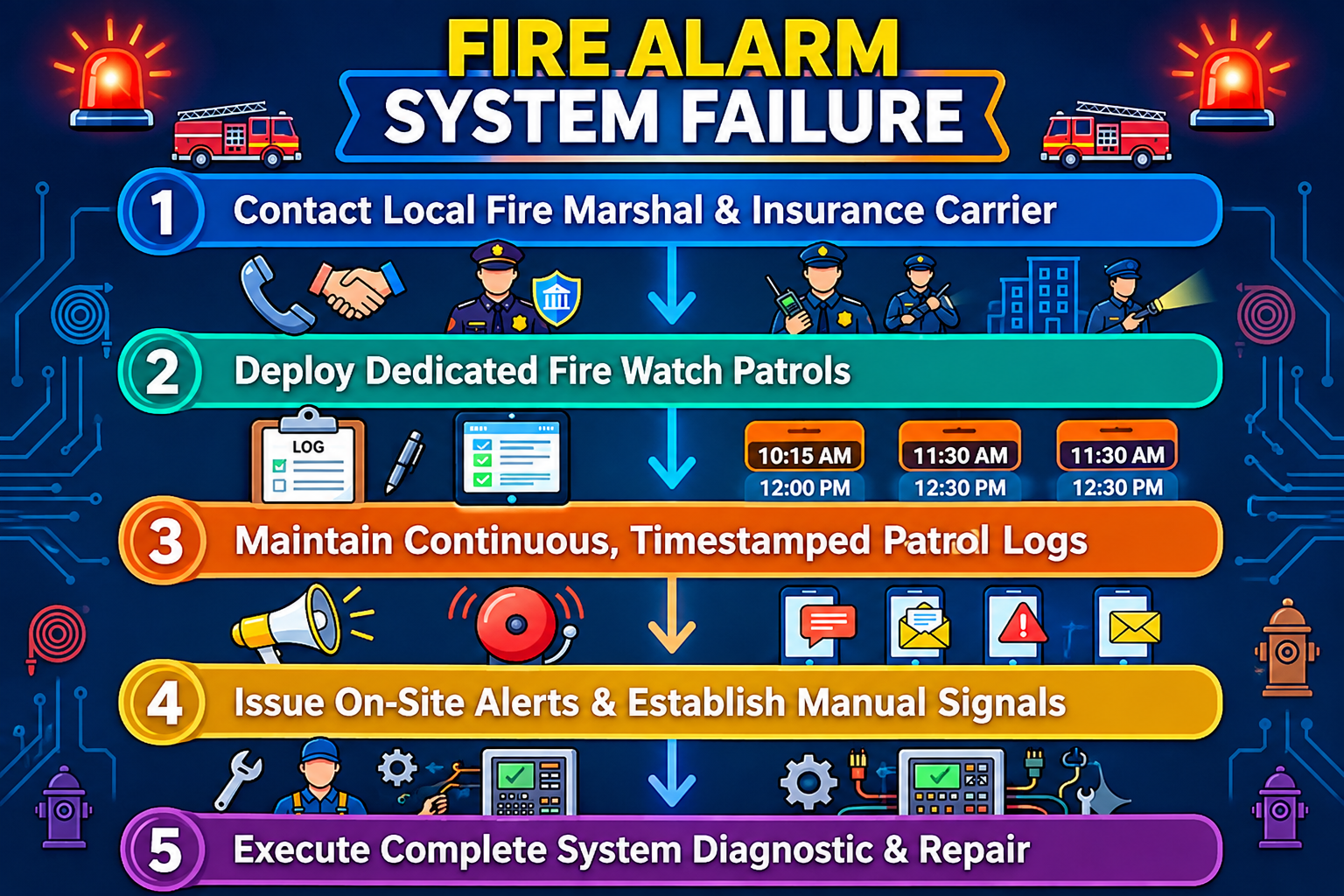
The failure of the fire alarm system will put your commercial building, industrial facility, or residential complex in serious danger both on a regulatory and physical level. Be it an electrical disruption, a malfunctioning control panel, a broken line, or a scheduled upgrade of the entire system, if the fire alarm system is malfunctioning, then your building would not have any automated early warning detection system.
During these situations, city codes require that the property owners maintain a human backup system to replace the automated fire detection system. Reacting to the situation would mitigate the expected damages and keep people safe in the facility. After monitoring the severity of the situation, hiring dedicated Fire Watch Services will inform you about the most appropriate actions with regard to the malfunctioning fire detection system.
Here are the five main actions that should be taken right away after the fire alarm signal goes off.
Quick Overview: Emergency Outage Compliance Checklist
|
-
Contact the Local Fire Marshal Immediately
According to the National Fire Protection Association (NFPA 101 Life Safety Code), property managers are required to inform the local Authority Having Jurisdiction (AHJ), which is normally your fire marshal, when any life safety system is out of service for four hours or more in a 24-hour period.
When reporting the outage of a working system, you will have to present:
- The fault itself (a breakdown of the main electrical panel, a malfunction of a sprinkler head, or a failure in communication).
- The exact areas within the premises were affected because of that fault.
- The time your technicians will need to fix the fault.
Failure to report the problem in a timely manner can lead to penalties, civil liability, or local authorities formally ordering vacating the premises.
-
Deploy Dedicated Guards for Continuous Monitoring
Once the fire marshal has been contacted, assuming the role of human visual surveillance, your immediate task is to have someone on site at all times. Professional Fire Watch Services can provide safety personnel to supervise your premises where necessary to detect smoke, hot spots, chemical threats, or flames.
Fire watch guards should perform only life safety duties and must not serve as receptionists, perform routine maintenance jobs, or undertake janitorial service duties. With proper guarding presence, one can ensure that the professionals can monitor every floor and staircase while checking all hidden utility rooms.
-
Document Everything with Detailed Patrol Logs
When firefighting staff go around the building, the patrol logs record everything that is happening. Fire inspectors, city inspectors, and insurance agents always check the logs during a fire emergency to prove that the security patrols have been carried out as planned. The patrol rounds are usually done every 30 to 60 minutes.
Your patrol logs must include important pieces of information:
- Time and Location: Precise timestamped entries for every completed floor or zone walk.
- Personnel Identification: Full name and signature of a safety officer on duty.
- Observed Conditions: A record of exactly what happened, i.e., whether emergency exits were clear, fire doors were functional, or hot work was going on.
With The Fast Fire Watch Company in charge, property managers can enjoy real-time GPS tracking and photo logging, thus generating records that cannot be changed and will pass stringent fire inspections.
-
Inform Occupants of the Building and implement Manual Precautions
As soon as the automated alarm systems, bells, and public address systems stop working, a manual warning procedure should take effect so as to warn the occupants in case of an emergency situation requiring evacuation.
Conduct a tour of the building, making sure to inform key personnel, tenants, and staff about the fact that the alarm system is not working, and employ normal security procedures for this case:
- Specify the items to be used for manual warning: horns, whistles, public addressing system.
- Remind the staff about the necessity to keep the corridors, fire doors, and stairs free of any obstructions.
- Suspend high-risk functions that are not essential. For example, welding, cutting, and hot electrical work should be suspended until the complete system restoration is accomplished.
-
Communicate with Licensed Technicians for Recovery
After establishing manually operated patrols and ensuring that all employees are trained about the situation, the next logical task to do is to deal with an issue with either mechanical or electrical systems. Be sure to reach out to licensed contractors for the detection of problems related to the main panel circuit, in the course of which either smoke detectors will be replaced or the water supply system will be restored.
Make sure that regular patrols are conducted at all times until a licensed technician provides a full testing of the system and the fire marshal provides the approval for fire hazard elimination.
Frequently Asked Questions
What is considered a fire alarm system failure?
Fire alarm system failure takes place when a very important element fails (for example, smoke detectors, water flow switch, alarm horns, or a control panel), thus making a building devoid of the possibility to provide any fire warnings.
How quickly should fire watch patrols commence following a failure?
According to many municipal ordinances, manual patrols must commence within four hours after the ignition of an alarm. Nevertheless, managers frequently contact The Fast Fire Watch Company right away to halt instances of no coverage.
Can internal workers undertake fire watch service?
In theory, internal maintenance staff can cover the first patrols; however, life safety regulations state that security personnel must be unengaged in other duties.