
Solid Oak Wood Kitchen Cabinets: 5 Quality Benchmarks Every Buyer Should Demand Before Purchasing
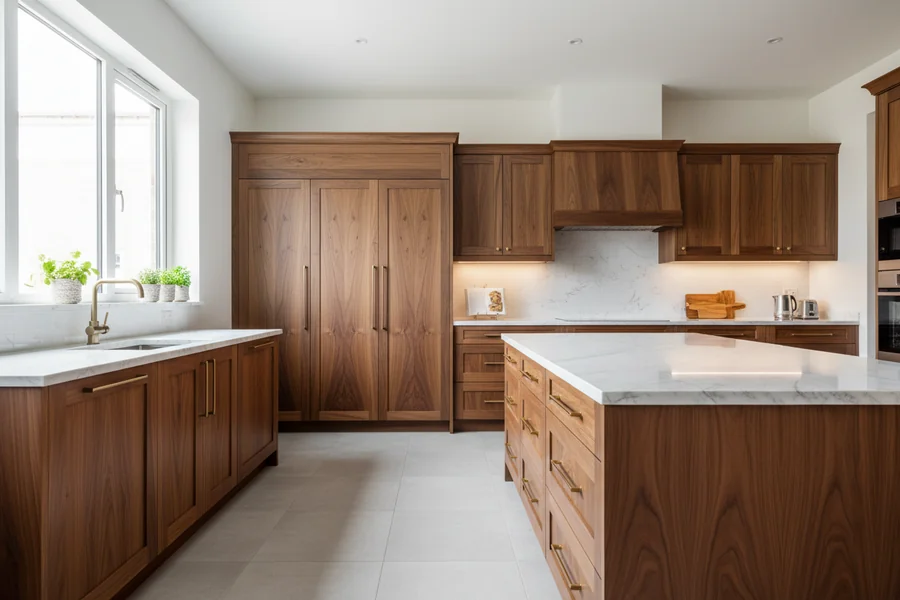
Kitchen cabinets represent one of the most permanent decisions made during a home renovation or construction project. Unlike appliances, flooring finishes, or fixtures, cabinetry is rarely replaced on a short cycle. A set of poorly chosen cabinets creates compounding problems over years — warping doors, failing joints, surfaces that resist cleaning, and hardware that loosens under daily use. For anyone managing a renovation budget carefully, or a contractor specifying materials for a client, these are not abstract concerns. They are operational realities that surface within the first few years of use.
Oak has remained a consistent choice in residential construction for good reason. It is dense, stable, and holds finishing compounds well. But not all oak cabinetry is produced to the same standard. The material itself can be compromised by low-grade milling, poor joinery, inferior finishing, or inadequate hardware. Buyers who evaluate cabinets based on appearance alone — the grain pattern, the color, the door style — often miss the structural and compositional details that determine actual longevity. The five benchmarks outlined here are designed to give buyers a clear framework for assessing cabinetry quality before a purchase is finalized, not after installation has already begun.
Understanding What Makes Oak a Technically Demanding Material
When evaluating solid oak wood kitchen cabinets, it helps to understand the specific properties of oak that distinguish it from softer hardwoods and engineered alternatives. Oak is an open-grain hardwood, which means its cellular structure contains visible pores that run along the length of the grain. This characteristic makes oak exceptionally receptive to stains and finishing oils, but it also means that poor preparation before finishing will result in uneven color absorption, blotching, and surface inconsistencies that become more pronounced over time.
Oak also responds to humidity changes in a measurable way. When cabinet components are cut from wood that has not been properly dried and acclimatized before milling, the panels will continue to expand and contract after installation. This movement can crack paint, gap joints, and introduce structural weakness in frames that were otherwise assembled correctly. According to general wood science principles documented by the USDA Forest Products Laboratory, moisture content management during the manufacturing process is one of the most significant factors in determining the dimensional stability of wood products after installation.
Understanding these material properties gives buyers a more accurate basis for the questions they should be asking suppliers and manufacturers. It shifts the evaluation from aesthetic preference to structural accountability.
Why Moisture Content Is a Pre-Purchase Concern, Not a Post-Installation Discovery
Most buyers assume that wood supplied by a cabinet manufacturer has been properly dried. In practice, this is not always the case, particularly with lower-cost production lines where speed of output takes priority over material conditioning time. Wood that has been rushed through the kiln-drying process retains moisture unevenly — outer layers may test dry while interior sections remain wet. When this wood is cut, shaped, and assembled into cabinet boxes and doors, it continues releasing moisture after the cabinets are installed in a kitchen environment.
The consequences are not always immediate. In the first months after installation, the cabinets may look and function exactly as expected. But within one to two years, the cumulative effect of unchecked moisture release becomes visible: door panels shift within their frames, drawer boxes lose their square geometry, and face frames develop hairline cracks at glue joints. These are not signs of accidental damage. They are the direct result of a material conditioning failure that occurred before the cabinets were ever assembled.
Buyers should request documentation of the wood’s moisture content at time of manufacturing, or at minimum, ask suppliers directly about their kiln-drying process and acceptable moisture tolerances before any purchase commitment is made.
Benchmark One: Frame and Box Construction Method
The box that forms the body of each cabinet unit is the structural foundation from which doors, shelves, drawers, and hardware all operate. How that box is built — the joints used, the thickness of the panels, the method of connecting face frames to carcasses — determines how the cabinet absorbs the mechanical stress of daily use over many years.
There are two dominant construction approaches in cabinet manufacturing. Face-frame construction uses a separate solid wood frame attached to the front of the cabinet box, which adds rigidity and a traditional visual depth. Frameless, or full-access, construction relies on the structural integrity of the box itself, with door and drawer hardware mounted directly to the box panels. Both approaches can produce durable cabinets, but the quality of execution within each method varies significantly.
How Joinery Methods Indicate Manufacturing Rigor
The connection points within a cabinet box are where structural failure most commonly originates. Cabinets assembled with mechanical fasteners alone — staples and screws driven through particleboard or thin plywood panels — will loosen under the repeated load cycles created by opening and closing doors and drawers. Over time, the fasteners pull through the panel material, the box loses its square alignment, and doors begin to hang unevenly or fail to close properly.
Higher-quality construction uses a combination of methods: dado joints, where panels are set into routed channels rather than simply butted together; glued connections that distribute stress across a broader surface area; and mechanical fasteners as a secondary reinforcement rather than the primary structural element. This approach creates a box that resists racking, maintains its square geometry under load, and does not depend on any single fastener to hold its shape. When evaluating cabinets at a showroom or through a manufacturer’s specification sheet, ask specifically how the box corners are joined and whether dado construction is used on shelf supports and cabinet bottoms.
Benchmark Two: Door Construction and Panel Movement Design
Cabinet doors are the most mechanically active component in a kitchen. They are opened and closed hundreds of times per month, exposed to steam, cleaning chemicals, grease, and temperature fluctuations, and they form the primary visual surface of the kitchen. In solid oak cabinetry, door construction requires particular attention because oak panels will expand and contract seasonally regardless of how well the kitchen is climate-controlled.
A properly constructed solid wood door accounts for this movement through its design. Frame-and-panel construction, where a floating center panel sits within a solid wood frame without being glued at the panel edges, allows the center panel to move independently as humidity levels change. This design has been used in furniture and cabinetry for centuries specifically because it prevents cracking and splitting under conditions that would destroy a rigid, fully glued panel assembly.
The Difference Between Engineered and Solid Oak Door Panels
Some cabinet lines marketed as solid oak use a combination of solid oak on visible surfaces and engineered wood composites on concealed surfaces or interior panels. This is not inherently problematic, but buyers should understand exactly what they are purchasing. A door with a solid oak stile and rail frame surrounding an MDF center panel will behave differently over time than an all-solid construction, particularly if the MDF is exposed to moisture through a failed edge seal or an improperly sealed finish.
The distinction matters most in kitchens with high steam exposure — near dishwashers, cooking ranges, or sink areas. In these locations, engineered panel cores are more susceptible to swelling and delamination than solid wood, and the visual and structural damage that results is difficult to repair without full door replacement. Understanding the exact composition of every door component before purchase prevents this class of problem entirely.
Benchmark Three: Finish Quality and Surface Protection
The finish applied to solid oak cabinetry is not a cosmetic detail. It is the primary barrier between the wood and the kitchen environment, and its quality determines how well the cabinet surface resists staining, moisture absorption, and surface degradation from cleaning agents used over the life of the kitchen.
Factory finishes applied under controlled conditions — where temperature, humidity, and application thickness are managed consistently — produce a harder, more even protective layer than field-applied finishes. Catalyzed conversion varnishes and polyurethane finishes applied in multiple coats with sanding between each application create a surface that resists penetration far more effectively than a single-coat finish applied quickly to move product through a production line.
What Surface Inconsistencies Reveal About the Finishing Process
A careful inspection of cabinet finish quality is one of the most accessible quality checks a buyer can perform before purchase. Surface variations in gloss level, areas where the grain has raised under the finish, drips or runs in corners, and uneven color across a single door panel are all indicators of a finish process that was not adequately controlled. These are not minor aesthetic flaws. They indicate that the protective film forming over the wood is uneven in thickness, which means some areas will wear through, absorb moisture, or discolor faster than others.
Run a hand across the door surface and along the edges of the frame. A properly finished surface should feel uniformly smooth. Rough texture at the edges or in recessed areas of a raised panel door suggests the finish was not adequately applied to these surfaces, which are often the first points of failure in a kitchen environment.
Benchmark Four: Hardware Specification and Mounting Integrity
Cabinet hardware — hinges, drawer slides, pulls, and adjusters — is the mechanical interface between the user and the cabinet structure. The quality of hardware specified by a manufacturer and the method by which it is mounted to the cabinet box directly affects how the cabinets function day to day, and for how long they function without adjustment or replacement.
Concealed hinges with soft-close mechanisms have become the standard specification for quality cabinetry because they reduce impact stress on both the door and the cabinet frame over thousands of open-close cycles. But the hinge itself is only part of the equation. The mounting plate attached to the cabinet box must be set into solid wood or high-density panel material — not stapled into thin veneer or low-grade particleboard — for the adjustment screws to hold their position and the hinge to remain aligned over time.
Drawer System Specifications and Weight Capacity as Quality Indicators
Drawer slides are among the most frequently stressed components in any kitchen cabinet installation. Lower-cost roller slides mounted to the sides of drawer boxes will flex under lateral load, produce noise over time, and lose smooth operation as their plastic components wear. Full-extension undermount slides with soft-close dampers, rated for appropriate weight capacity, represent a measurably more durable specification. They keep the drawer box supported at the bottom, which reduces the racking force placed on the box joints, and they allow full access to the drawer’s contents without the drawer pulling forward under its own load.
When reviewing cabinet specifications, ask for the drawer slide brand and weight rating. This information is readily available from any manufacturer using quality hardware, and reluctance to provide it is itself useful information about the product’s specification level.
Benchmark Five: Warranty Terms and What They Actually Cover
A warranty is not simply a customer service document. It is a manufacturer’s stated confidence in their own product, and the specific terms of a warranty reveal how that manufacturer expects their cabinets to perform over time. A limited lifetime warranty that excludes finish, hardware, and installation-related issues is a fundamentally different commitment than a comprehensive warranty that covers all components under normal use conditions.
Before purchasing any cabinet line, read the warranty document carefully. Look specifically for what is excluded — whether finish wear, water damage from normal kitchen conditions, or hardware failure falls outside coverage. Understand whether the warranty transfers if the home is sold, as this affects the resale value of the renovation. And ask the supplier whether warranty claims require returning to the manufacturer directly or whether the local dealer handles service. A warranty that is difficult to execute provides significantly less protection than one that is straightforward to claim.
How Warranty Scope Reflects Manufacturing Confidence
Manufacturers who produce cabinets with genuine material integrity and controlled finishing processes do not need to carve out extensive exclusions to manage their warranty costs. They know their product will hold up because their process is designed to produce consistent results. Manufacturers who rely on favorable exclusion language to limit exposure often do so because they have operational knowledge that certain components or finishes will fail at a rate that makes broad coverage financially unsustainable. Interpreting warranty terms through this lens gives buyers a secondary signal about manufacturing quality that goes beyond what any showroom presentation can convey.
Making a Considered Decision
Purchasing kitchen cabinetry is a long-term materials decision, and it deserves the same structured evaluation that buyers apply to roofing, flooring, or structural components. Solid oak cabinetry represents a meaningful investment precisely because the material, when properly sourced, milled, assembled, and finished, has the capacity to function without significant degradation for decades. The benchmarks outlined here — wood conditioning, box construction, door design, finish quality, hardware specification, and warranty scope — give buyers a consistent framework for separating cabinetry that will deliver on that potential from cabinetry that simply resembles it at the point of sale.
No single benchmark is sufficient on its own. A beautifully finished door mounted in a poorly constructed box will still fail. A well-built box fitted with substandard drawer slides will produce operational frustration within years. Quality in cabinetry is a system, not a feature, and buyers who evaluate all five dimensions before committing to a purchase significantly reduce the likelihood of costly remediation after installation is complete. The time spent asking the right questions before purchase is far less expensive than the time and cost of addressing avoidable failures afterward.