
From Wellhead to Valve Body: A Complete Guide to CNC Machining Applications in the US Oil and Gas Industry
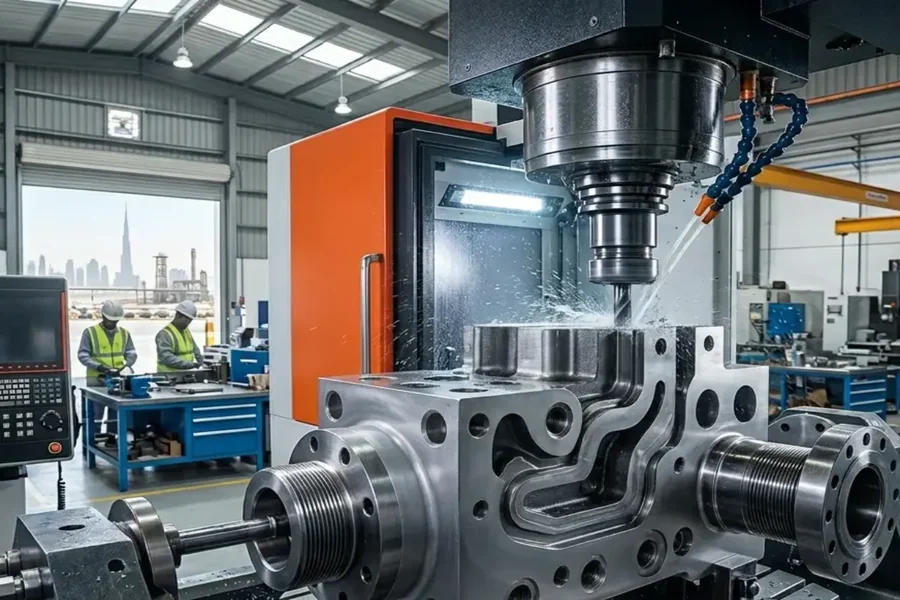
The oil and gas industry operates under conditions that most manufacturing sectors never encounter. Components must perform reliably in environments where pressure, temperature, and chemical exposure combine in ways that leave little margin for dimensional error or material inconsistency. A valve body that leaks under pressure, a fitting that fails at a wellhead connection, or a housing that corrodes prematurely does not simply create a production delay — it creates a safety event with regulatory, financial, and reputational consequences.
Against that backdrop, CNC machining has become a foundational process across the upstream, midstream, and downstream segments of the industry. The ability to produce complex, tight-tolerance parts from hard alloys and engineered materials — at consistent quality across production runs — addresses the core reliability demands that oil and gas operations place on their supply chains. This guide examines where CNC machining fits within those operations, what makes it effective for this industry specifically, and why procurement and engineering teams continue to depend on it for both standard and critical components.
What Oil and Gas CNC Machining Actually Involves
At its core, oil and gas cnc machining refers to the computer-controlled removal of material from metal stock to produce components that meet precise geometric and dimensional requirements. The process uses rotating cutting tools, controlled axis movement, and programmed toolpaths to shape parts from raw billets, castings, or bar stock into finished components ready for assembly, testing, or field installation. Unlike general industrial machining, work in this sector involves a narrower set of accepted materials, a stricter certification environment, and a higher consequence threshold for defects.
For teams sourcing components for downhole tools, surface equipment, or processing infrastructure, understanding what oil and gas cnc machining encompasses helps clarify why it differs from standard contract machining. Shops serving this industry must maintain documentation trails, work with materials that carry mill certifications, and often comply with standards set by bodies such as the American Petroleum Institute, which governs specifications for wellhead equipment, valves, and pressure-containing components. These requirements shape every stage of the manufacturing process, from material procurement through final inspection.
Material Selection and Its Operational Implications
The materials used in oil and gas components are chosen for their resistance to specific failure modes — corrosion from hydrogen sulfide, erosion from abrasive slurries, deformation under sustained high pressure, or embrittlement at temperature extremes. Common choices include stainless steel grades, duplex and super-duplex alloys, Inconel, titanium, and various tool steels. Each of these materials presents distinct machining challenges related to heat generation, tool wear, and surface integrity.
A shop that machines aluminum or mild steel for general manufacturing is not automatically equipped to produce components from duplex stainless or nickel alloys. These harder, more work-hardening materials require specific tooling strategies, cutting parameters, and coolant management approaches to maintain dimensional accuracy and surface finish without inducing stress or microstructural damage. When procurement teams select a machining partner, the shop’s demonstrated experience with relevant alloys is not a secondary consideration — it is often the primary one.
Tolerances and Why They Matter Beyond the Blueprint
In oil and gas applications, dimensional tolerances on machined parts are not arbitrary specifications set by engineers to be conservative. They are derived from the functional requirements of the assembly — the clearance needed for a seal to seat correctly, the surface finish required for a metal-to-metal valve contact, or the concentricity needed for a rotating downhole assembly to run without vibration. When those tolerances are not met, the failure mode is often not visible during assembly. It manifests in the field, under load, in conditions where intervention is costly and sometimes hazardous.
This is why inspection and measurement are not peripheral steps in oil and gas machining. CMM verification, surface profilometry, and traceability of inspection records are standard expectations, not premium services. The tolerance itself matters, but the documented evidence that the tolerance was achieved — and that the measurement process was controlled — matters equally to quality managers and end users alike.
Upstream Applications: Wellhead and Downhole Components
Upstream operations, which encompass exploration, drilling, and production, depend heavily on machined components that must withstand the physical conditions found thousands of feet below surface. Wellhead assemblies, Christmas tree components, drill collars, stabilizers, and various downhole tool bodies are routinely produced through CNC machining. These parts carry pressure-containing functions or structural loads that make dimensional accuracy a safety-critical requirement, not merely a quality preference.
Wellhead components in particular must conform to API specifications that govern thread profiles, pressure ratings, and material grades. The machining of wellhead bodies, spools, and flanges involves multi-axis work to produce complex internal geometries, port configurations, and sealing surfaces that must remain consistent across every unit in a production run. In high-volume drilling programs, the consistency of these components directly affects installation time and pressure testing outcomes at the wellsite.
Downhole Tool Bodies and the Case for Tight Process Control
Downhole tools — including measurement-while-drilling (MWD) housings, logging tools, and completion equipment — require machined components that hold tolerance even after thermal cycling and exposure to drilling fluid. The housings for these tools are often long, slender structures machined from high-strength alloys, where straightness, bore concentricity, and thread accuracy determine whether the tool functions as designed or requires costly replacement.
Because downhole tool rental and service companies operate on tight asset utilization schedules, the turnaround time and quality consistency of machined components directly affects their business model. A shop that can reliably hold specified dimensions on a tool housing across a batch of twenty units — rather than requiring rework on a portion of that batch — reduces operational friction for the service company and ultimately supports uptime in the field.
Midstream Applications: Valves, Fittings, and Flow Control Components
Midstream infrastructure — pipelines, compressor stations, processing facilities, and terminal equipment — relies on a broad range of machined components for flow control, pressure management, and fluid handling. Valve bodies, ball components, gate and seat rings, manifold blocks, and various fitting configurations represent the core of midstream machining demand. These components must maintain sealing integrity across large pressure differentials and, in many cases, across decades of service life.
Valve bodies present a representative example of what midstream machining involves. A single valve body may require facing, boring, thread cutting, port machining, and surface finishing across multiple setups. The internal geometry must allow the valve mechanism to operate with consistent torque and without leakage, while the external connections must match pipe flange or thread standards precisely. Any deviation in the seating surfaces or port geometry translates directly into valve performance issues.
Manifold Blocks and Custom Flow Path Machining
In processing facilities and compressor stations, hydraulic and pneumatic control systems rely on machined manifold blocks that consolidate multiple flow paths into a single body, replacing networks of fittings and tubing that would otherwise introduce leak points. These blocks are typically machined from solid bar or plate stock, with intersecting drilled passages, ported connections, and mounting features that must align precisely with the equipment they serve.
The machining of manifold blocks requires careful planning of hole sequences to manage intersecting passages without burrs or obstructions in the flow path. Deburring of internal passages, pressure testing, and cleanliness verification are standard steps before these components enter service. For facilities operators, the reliability of manifold blocks has a direct impact on control system uptime and the integrity of automated process systems.
Downstream Applications: Refinery and Processing Equipment Components
Downstream operations encompass refining, petrochemical processing, and distribution, where machined components appear in heat exchangers, reactor vessels, pump housings, compressor parts, and instrumentation hardware. The operating environments in refineries introduce additional complexity: elevated temperatures, aggressive chemical exposure, and the need for components that can be removed, inspected, and reinstalled within maintenance windows that are often measured in hours rather than days.
Pump and compressor components represent a significant share of downstream machining work. Impellers, wear rings, shaft sleeves, and bearing housings require machining to close tolerances to ensure rotodynamic balance and proper clearance fits. In a refinery environment, a pump that vibrates due to an out-of-balance impeller or runs hot due to incorrect clearances is not a minor inconvenience — it is a maintenance event that affects throughput and can escalate to an unplanned shutdown if not addressed promptly.
Replacement Parts and the Challenge of Legacy Equipment
Refineries and chemical plants often operate equipment that has been in service for thirty or forty years. Original equipment manufacturers may no longer support these assets, and spare parts may be unavailable through standard supply channels. In these situations, CNC machining from drawings, reverse-engineered measurements, or sample parts allows maintenance teams to produce functional replacements without replacing the entire equipment assembly.
This application of machining — producing custom or legacy replacement components — requires shops with strong process engineering capability and the flexibility to work from incomplete information. The ability to produce a single replacement impeller or a small batch of obsolete valve seats from a sample or technical drawing is a meaningful capability for plant maintenance organizations managing aging infrastructure on constrained capital budgets.
Quality Systems and Supplier Qualification in Oil and Gas Machining
The quality expectations in oil and gas machining extend beyond dimensional inspection. Shops serving this sector are typically expected to maintain quality management systems certified to ISO 9001, and in many cases to additional standards such as API Q1 for suppliers of petroleum and natural gas industry equipment. These frameworks govern how a shop controls its processes, manages nonconformances, maintains calibration records, and handles customer-specific requirements.
For procurement and supply chain teams, supplier qualification in this industry is not a one-time event. It involves ongoing audits, performance tracking, and periodic reassessment of whether a supplier’s capabilities and quality systems still align with the buyer’s requirements. The cost of a nonconforming part reaching a critical application — in rework, replacement, lost production, or incident investigation — consistently exceeds the cost of a thorough qualification process on the front end.
Traceability as a Standard Expectation
Material traceability is a baseline requirement in oil and gas machining, not an optional service tier. Every pressure-containing or structurally critical component should be traceable back to its mill certificate, heat number, and chemical analysis. This traceability allows quality teams to conduct material reviews if a performance issue is identified in the field, and it supports the documentation requirements of regulatory and insurance frameworks that govern production facilities.
Shops that cannot provide material traceability documentation, or that treat it as an administrative burden rather than a core process requirement, present a real risk for buyers operating in regulated environments. When evaluating machining suppliers, the ability to produce a complete documentation package — drawings, material certifications, inspection records, and nonconformance history — is as important as the shop’s equipment list or delivery performance.
Closing Considerations for Engineers and Procurement Teams
CNC machining occupies a central position in the supply chain for oil and gas components because the industry’s operating conditions make process control, material integrity, and dimensional consistency non-negotiable. From the wellhead to the refinery, the components that keep production running safely and efficiently are, in many cases, machined parts produced to documented specifications by suppliers who understand the stakes involved in this sector.
For engineers specifying components and procurement teams building supplier networks, the practical takeaway is consistent: the selection of a machining partner in this industry should be grounded in their demonstrated experience with relevant materials and component types, their quality system maturity, and their ability to support documentation requirements throughout the part’s lifecycle. Price and lead time matter, but they operate within a framework where reliability and traceability define the minimum acceptable standard.
The segments of the industry covered in this guide — upstream drilling and completion, midstream flow control, and downstream processing — each present distinct machining requirements, but they share a common expectation: that the part delivered will perform as specified, every time, with documentation to support that claim. Meeting that expectation consistently is what separates capable machining suppliers from those who create risk for the operations they serve.