
Solid Gold vs. Gold-Plated vs. Vermeil: What You’re Actually Paying For
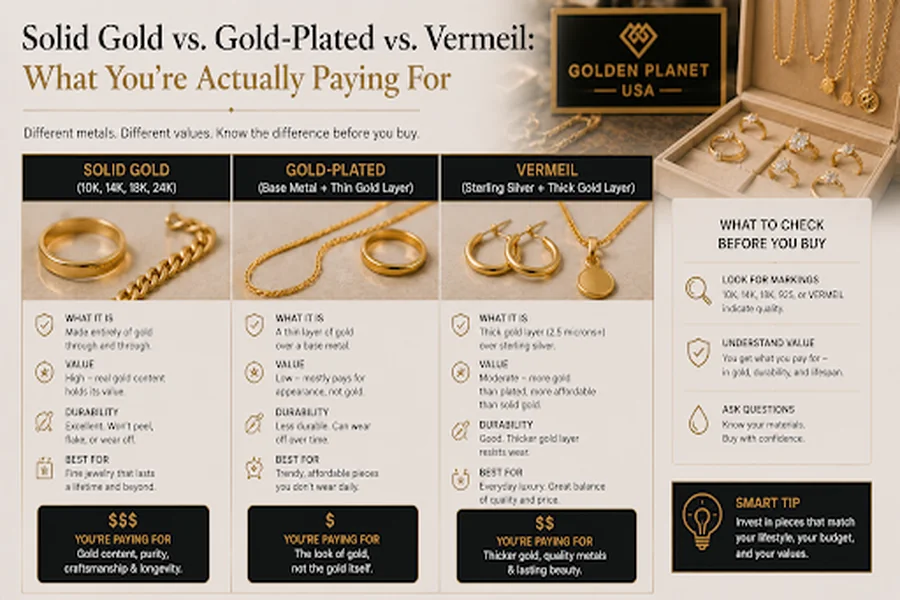
You’ve probably seen all three words on the same shopping page, sometimes describing pieces that look nearly identical and cost wildly different amounts. Solid gold. Vermeil. Gold-plated. They sound like they might be small variations on the same idea, but they’re not, and the difference shows up fast once you own the piece for more than a few months. Golden Planet USA, a manufacturer of gold jewelry, sees this confusion play out constantly among shoppers who assumed they understood what they were buying until something started wearing thin.
Three Terms That Get Thrown Around Loosely
Part of the problem is that sellers don’t always use these terms carefully. Some do it out of genuine confusion about the categories themselves. Others lean into the ambiguity because “gold” sounds better in a product title than “gold-plated,” even when the second one is technically accurate. Either way, the result is the same for the buyer: three very different products get marketed with language that makes them sound interchangeable, when they’re anything but.
Solid Gold
Solid gold means exactly what it sounds like. The piece is gold all the way through, not just on the surface, measured in karats that indicate how pure that gold actually is. Pure gold is 24 karat, but it’s too soft to hold up well in everyday jewelry, so it gets mixed with other metals to add strength. That’s where 10K, 14K, 18K, and 21K come from, each representing a different ratio of gold to alloy. Because the entire piece contains real gold rather than just a surface layer, its value is tied directly to the gold market itself. When gold prices move, so does the underlying worth of what you’re wearing, which is not true of the other two categories.
Gold Vermeil
Vermeil sits in the middle, and it’s the one most people misunderstand. A vermeil piece has a base of sterling silver coated with a layer of real gold, but not just any thin coating. U.S. standards require that layer to be at least 2.5 microns thick and at least 10 karat gold, which is significantly more substantial than what you’ll find on typical plated jewelry. That thickness is what gives well-made vermeil real staying power compared to a cheap gold wash, even though the core of the piece is still silver rather than gold.
Gold-Plated
Gold-plated jewelry starts with a base metal, often brass or copper, and adds a thin layer of gold on top, sometimes measured in fractions of a micron. There’s no minimum thickness requirement the way there is with vermeil, which means plating quality varies enormously between brands. This is why gold-plated pieces are the ones most likely to show brassy or dull patches after regular wear. The gold simply isn’t thick enough to withstand daily friction the way a heavier coating or solid metal would.
Quick Comparison
| Factor | Solid Gold | Vermeil | Gold-Plated |
| Durability | Excellent, lasts decades | Good, holds up with care | Wears thin over time |
| Price | Highest | Mid-range | Most affordable |
| Maintenance | Minimal | Occasional care | Frequent, may need re-plating |
| Resale value | Tied to gold market | Limited, mostly silver value | Little to none |
How to Tell What You’re Actually Buying
A little detective work before you buy can save you from a disappointing surprise a few months in.
Check the Stamp or Hallmark
Legitimate solid gold jewelry is almost always stamped somewhere discreet, like the inside of a ring band or the clasp of a necklace, with a mark like 14K, 585, or 18K. Vermeil pieces are typically stamped 925 for the sterling silver base, sometimes alongside a note about the gold layer. If you can’t find any stamp at all, that’s worth asking about directly rather than assuming.
Ask for Certification, Not Just a Label
A product description saying “gold” isn’t proof of anything. A reputable seller should be able to tell you the exact karat, and ideally back it up with documentation rather than just a confident answer. This matters most when comparing solid gold vs. gold plated vs. vermeil pieces that look nearly identical in photos, since the description alone often won’t tell you which category you’re actually looking at.
Which One Is Right for You
There’s no universally correct answer here, and honestly, all three have a real place depending on how you shop and wear jewelry. If you’re buying something you’ll wear daily for years, or want a piece that holds real resale value, solid gold is worth the higher price simply because the value is genuinely built into the metal. If you love changing up your jewelry often and want more gold-toned pieces without the full solid gold price tag, a comparison of vermeil vs. gold plated usually favors vermeil, since the thicker gold layer holds up noticeably better over time. And if budget is the main concern and you’re fine replacing pieces every year or two, gold-plated can still make sense for occasional wear or trend pieces you won’t keep forever. The honest answer to solid gold vs. gold plated often comes down to how long you actually expect to keep wearing the piece.
The Bottom Line
None of these three options is inherently better in every situation, but knowing the real difference between them means you’re paying for what you actually think you’re buying. A quick look at vermeil vs. solid gold, or a check of the stamp inside a ring, takes thirty seconds and can save you from a piece that looks the same on day one but tells a very different story a year later.