
Driving Business Growth: The Intersection of HR Strategy and Digital Marketing
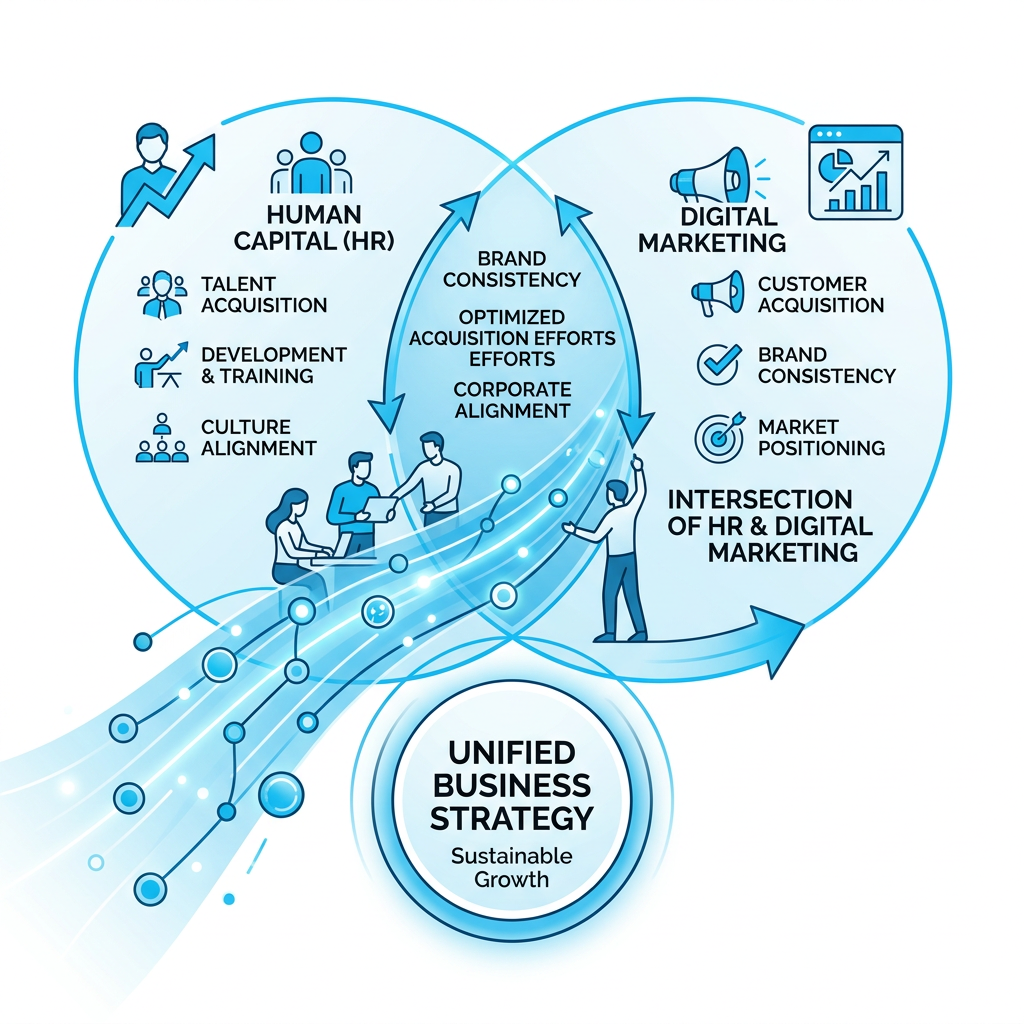
Aligning Human Capital and Digital Marketing Under a Unified Business Strategy
In an increasingly dynamic business landscape, the synergy between human capital and digital marketing is paramount. Achieving sustainable growth requires more than just independent departmental excellence; it demands a unified Business Strategy that aligns every function towards common objectives. This holistic approach ensures brand consistency, optimizes customer acquisition efforts, and ultimately drives corporate alignment.
Consider a thriving Home service business strategy – its success isn’t solely dependent on brilliant marketing campaigns or a highly skilled workforce. It’s the seamless integration of both: a digital marketing team that understands the capabilities and training of the service technicians, and an HR department that recruits and develops talent specifically for the digital channels and customer experience promised by marketing. This strategic coherence minimizes wasted resources and maximizes market positioning.
The rapid evolution of technology, particularly artificial intelligence, is further blurring traditional lines. We recognize that more than 80% of strategy tasks now face high or medium exposure to AI automation and augmentation. This means both HR and digital marketing functions must strategically adapt, leveraging AI to enhance efficiency and insight, rather than simply automating existing processes. Effective resource allocation in this AI-first world requires a clear strategic vision that guides technological adoption across all business units.

Defining Business Strategy vs. Tactics in the Digital Era
To effectively align human capital and digital marketing, it’s crucial to first understand the fundamental difference between strategy, business plans, and tactics. A Business Strategy serves as our long-term roadmap, outlining the overarching direction and competitive approach an organization will take to achieve its goals. It answers the “what” and “why.” For instance, a strategy might be to become the market leader in eco-friendly digital marketing solutions.
A business plan, on the other hand, is a more detailed document that translates this strategy into actionable steps, often covering financial projections, operational details, and marketing tactics for a specific period. It’s the blueprint for how we’ll execute. Tactics are the specific, short-term actions or operational executions employed to implement parts of the business plan and achieve strategic objectives. These are the “how.” For our eco-friendly example, a tactic might be running targeted social media campaigns on Earth Day, or developing an employee legal protections training program on sustainable practices.
The distinction is critical: strategy provides the guiding principles and sets the destination, while tactics are the specific maneuvers to get there. Without a clear strategy, tactics can be random and ineffective, leading to wasted effort and resources.
Feature Business Strategy Business Plan Tactics Purpose Defines long-term direction and competitive advantage. Detailed blueprint for executing strategy over a specific period. Specific actions to implement parts of the plan/strategy. Time Horizon Long-term (3-5+ years) Medium-term (1-3 years) Short-term (weeks, months) Scope Broad, overarching organizational goals. Comprehensive, covering all functional areas. Narrow, focused on specific tasks or campaigns. Flexibility Adaptable to market changes, but core vision stable. Detailed but subject to periodic review and adjustment. Highly flexible, can be changed quickly based on results. Key Question “What business are we in, and how will we win?” “How will we execute our strategy?” “What specific actions will we take now?” At the heart of any effective strategy is value creation. The “value stick” framework helps visualize this by considering the Willingness To Pay (WTP) of customers and the Willingness To Sell (WTS) of suppliers and employees. Our strategy aims to maximize the gap between WTP and WTS, creating value that can be shared among customers, the firm, employees, and suppliers. Digital marketing efforts can significantly increase customer WTP through brand building and perceived value, while HR strategies can enhance employee WTS through fair compensation and a positive work environment, all contributing to a robust overall strategy.
The Three Levels of Business Strategy: Corporate, Business, and Functional
Effective strategy operates at multiple interconnected levels within an organization, ensuring alignment from the broadest vision down to daily operations.
- Corporate-Level Strategy: This is the highest level, concerned with the overall scope and direction of the organization. It addresses questions like “What businesses should we be in?” and “How do we manage our portfolio of businesses?” Decisions at this level include mergers, acquisitions, diversification into new markets, and resource allocation across different business units. Historically, tools like the growth-share matrix were popular, with 45% of the Fortune 500 companies using some variation by 1979 to guide their portfolio management decisions. For a modern organization, this might involve deciding whether to invest more in a digital services arm versus a traditional consulting practice.
- Business-Level Strategy: This level focuses on how a specific business unit will compete within its chosen market. It answers “How will we compete in this particular business?” This involves defining our competitive advantage, whether through cost leadership (offering products/services at the lowest price) or differentiation (offering unique, high-value products/services). For example, our digital marketing unit might choose a differentiation strategy by specializing in AI-driven content creation for a niche market.
- Functional-Level Strategy: This is where the rubber meets the road, focusing on how each functional department (e.g., HR, marketing, operations, finance) supports the business-level strategy. It asks, “How can our function best contribute to achieving our business unit’s objectives?”
- Marketing Strategy: At this level, the digital marketing team develops specific plans for content creation, SEO, social media, paid advertising, and analytics, all aligned with the business unit’s competitive advantage. If the business strategy is differentiation through AI-driven content, the marketing strategy will focus on showcasing that unique capability.
- HR Strategy: Similarly, the HR team develops strategies for talent acquisition, development, performance management, and culture that support the overall business goals. If the business needs AI specialists for its digital marketing differentiation, HR’s strategy will involve recruiting those specific skills and fostering a culture of innovation.
The success of our overarching Business Strategy hinges on the seamless alignment of these three levels. A disconnect at any point can lead to inefficiencies, conflicting priorities, and ultimately, a failure to achieve strategic objectives.

Frameworks for Competitive Advantage: SWOT and the Value Stick
Developing a robust Business Strategy requires a deep understanding of both our internal capabilities and the external environment. Several frameworks serve as indispensable tools for this analysis, helping us identify opportunities for competitive advantage.
One of the most widely recognized and effective tools is the SWOT Analysis. This framework helps us assess our organization’s:
- Strengths: Internal capabilities and resources that give us an advantage (e.g., a highly skilled digital marketing team, strong brand reputation).
- Weaknesses: Internal limitations that might hinder our success (e.g., outdated technology, lack of a diverse talent pool).
- Opportunities: External factors that we can leverage for growth (e.g., emerging market trends, new technologies like generative AI).
- Threats: External factors that could pose risks to our business (e.g., intense competition, changing regulatory landscape).
By systematically analyzing these four areas, we gain a clear picture of our strategic position and potential pathways forward. For instance, a strength in our HR department’s ability to attract top digital talent, combined with an opportunity in the growing demand for personalized digital experiences, could inform a powerful Business Strategy.

Beyond SWOT, Porter’s Five Forces framework helps us understand the attractiveness and profitability of an industry by analyzing the bargaining power of buyers and suppliers, the threat of new entrants and substitute products, and the intensity of rivalry among existing competitors. This external analysis is crucial for positioning our business effectively.
Another vital concept is the Value Chain, which maps out all the activities a company performs to bring a product or service to market. By analyzing each step—from inbound logistics to marketing and sales to service—we can identify areas to create unique value or reduce costs. For example, integrating HR’s talent development with digital marketing’s content creation process can optimize the value chain, leading to better outcomes.
These frameworks guide us in creating sustainable competitive advantage. Whether we pursue differentiation by offering unique, superior services (e.g., highly personalized AI-driven marketing campaigns) or cost leadership by operating more efficiently than competitors, a well-informed strategy ensures we stand out in the marketplace. For a deeper dive into these foundational concepts, the Wikipedia page on Strategic management offers a comprehensive overview of its historical development and key theories.
Implementing and Measuring Strategic Growth Through Leadership
Strategy is only as good as its execution. This is where leadership plays an indispensable role. Effective leaders not only formulate brilliant strategies but also inspire, align, and empower their teams to bring those strategies to life. Our focus on human capital and digital marketing underscores the need for leaders who can bridge these functions and drive integrated performance.
The journey from strategic vision to tangible results is complex, requiring continuous effort in leadership development, talent retention, and fostering a robust organizational culture. We believe in cultivating leaders who embody Strategic servant leadership, prioritizing the growth and well-being of their teams while steering the organization towards its strategic goals. This approach builds trust, enhances engagement, and creates an environment where employees are motivated to contribute their best to the Business Strategy.
Building Leadership Pipelines and Succession Planning
A forward-thinking Business Strategy must include a robust approach to talent development, particularly in building strong leadership pipelines and effective succession planning. In today’s rapidly changing environment, future-proofing our organization means ensuring a continuous supply of capable leaders ready to step into critical roles. This is not just about filling vacancies; it’s about cultivating a deep bench of talent that can drive innovation and adapt to unforeseen challenges, enhancing organizational resilience.
Our approach involves identifying high-potential employees early, providing them with targeted development opportunities, and creating clear career pathing. This includes exposure to different functional areas, mentorship programs, and challenging assignments that stretch their capabilities. Even academic curricula, such as the Cambridge International AS & A Level Business syllabus for 2026, emphasize the importance of leadership and organizational structure as foundational elements of business success. By proactively investing in our leadership pipeline, we ensure that our human capital strategy directly supports our long-term Business Strategy.
Executive Coaching and Teaching Managers to Coach
To truly empower our workforce and execute our Business Strategy effectively, we advocate for comprehensive executive coaching and the development of managers as coaches. Executive coaching provides targeted, individualized support to senior leaders, helping them refine their strategic thinking, decision-making skills, and ability to inspire their teams. This personalized development is crucial for navigating complex challenges and leading strategic initiatives.
Beyond the executive level, teaching managers to adopt a coaching mindset transforms the entire organization. When managers are equipped with coaching skills, they can better engage their team members, foster problem-solving, and unlock individual potential. This approach leads to greater team empowerment, improved performance, and stronger leadership development at all levels. Our insights on Leadership Coaching: Unlock Potential highlight how this can significantly enhance a leader’s ability to guide and motivate. Furthermore, in an era of constant change, cultivating Resilient Leadership through coaching ensures that leaders can effectively navigate adversity and maintain strategic focus. Regular feedback loops, both formal and informal, are integral to this process, ensuring continuous learning and adaptation.
Measuring Strategic Success and Execution KPIs
Measuring the success of our Business Strategy is not merely about tracking financial outcomes; it’s about understanding the effectiveness of our execution and making timely adjustments. Key Performance Indicators (KPIs) are essential for this, providing tangible metrics that reflect progress towards strategic objectives.
While financial performance indicators like revenue growth, profitability, and Return on Invested Capital (ROIC) are crucial, we also focus on a blend of lead measures and lag measures.
- Lag measures are outcomes that we track after the fact (e.g., quarterly sales figures, market share, ROIC). They tell us if we achieved our goals.
- Lead measures are predictive, actionable activities that drive the lag measures (e.g., number of new digital marketing campaigns launched, employee training hours, customer engagement rates). These are the activities our teams can directly influence before the results appear.
For example, in our integrated HR and digital marketing strategy, a lag measure might be “increase qualified leads by 20%.” A corresponding lead measure could be “increase digital marketing team’s average weekly content output by 15%.” By focusing on lead measures, our teams can proactively impact the desired outcomes.
Continuous monitoring and evaluation are non-negotiable. Tools and methodologies from firms like McKinsey & Company strategy insights emphasize the importance of data-driven strategy and constant calibration. This involves regular reviews of KPIs, analyzing trends, and being prepared to pivot or adjust tactics as market conditions evolve or internal performance dictates.

The reality is that strategy execution is challenging. Despite robust planning, 90 percent of businesses fail to meet their strategic targets. This often stems from a disconnect between strategy formulation and the daily activities of the organization.

By meticulously defining our KPIs, focusing on both lead and lag measures, and maintaining a culture of continuous monitoring, we enhance our ability to execute our Business Strategy successfully. This disciplined approach ensures that our efforts in human capital and digital marketing are always aligned, measurable, and contributing directly to our long-term growth objectives.