
Overmolding Service & Rapid Tooling Service Guide
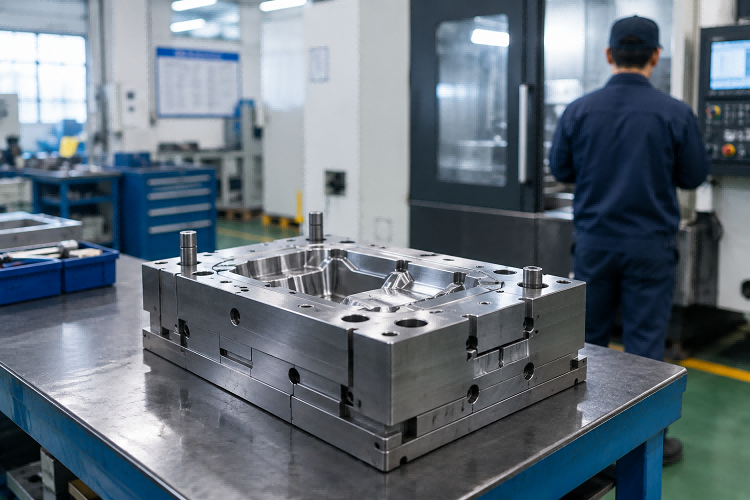
An overmolding service molds a soft or second material onto a rigid part, and a rapid tooling service builds the mold in 2-5 weeks instead of 6-8.
Product teams rarely get to choose between speed and quality. An overmolding service gives a part the soft grip, sealing surface or two-tone finish that customers notice, while a rapid tooling service gets the mold built in weeks rather than months. Used together, they let you test a finished-feeling part before you commit to expensive steel. This guide explains how each service works, where they overlap, and the design and sourcing mistakes that cause overmolded parts to fail.
What Is an Overmolding Service?
An overmolding service is an injection molding service that molds one material, usually a thermoplastic elastomer (TPE), over a rigid substrate to produce a single finished part. A toothbrush handle with a hard core and a rubbery grip is the classic example.
Designers use it to improve grip, dampen vibration, add two-color branding and cut out the assembly steps that gluing or snapping separate pieces would require. Tool handles, personal care products and medical devices are typical applications.
One distinction trips people up. Overmolding molds the substrate first, then moves it to a second mold for the soft layer. Insert molding is different: a preformed part, often metal, is loaded into a mold and plastic is injected around it.
How Does Overmolding Bond Two Materials?
Overmolding bonds materials through chemical adhesion between compatible polymers, through mechanical interlocks such as holes and undercuts, or through both at once. Which one you rely on decides whether the part survives real use.
Chemical Bonding
Pairing matters. ABS bonds well with most TPEs and TPU, polycarbonate bonds with TPE and TPU, and polypropylene needs TPE grades built on PP/EPDM chemistry. Nylon only works with grades formulated for it.
Treat supplier compatibility charts as a starting point. Order physical samples before you trust one.
Mechanical Bonding
Through-holes, undercuts and ribs let the soft material lock around the substrate. If a failed bond has consequences, as it would on a surgical handle, design the interlock in even when the chemistry looks favorable. Belt and braces is the right call here.
Design Rules That Prevent Common Failures
- Keep walls uniform. A wall thickness of roughly 0.060 to 0.120 in. supports good bonding in most applications, and transitions should be gradual.
- Watch shrinkage. Some styrenic TPEs shrink more than the substrate and can warp it. A stiffer substrate, added ribs, a thinner soft layer or a lower-hardness TPE all help.
- Gate with care. Gating directly on the bonding surface can wash or jet the substrate before the bond forms.
What Is a Rapid Tooling Service?
A rapid tooling service builds injection molds quickly and at lower cost, typically from aluminum or soft steel, so you can have molded parts in days to weeks. One molder puts rapid tool builds at roughly 2-5 weeks, against 6-8 weeks for many production steel tools.
Aluminum is the usual material because it machines five to ten times faster than steel, according to Formlabs, and it conducts heat well enough that cooling layouts can stay simple.
The trade-offs are real. Aluminum tools generally wear out sooner than hardened steel, cycle times can run longer, and features like side actions, undercuts and tight tolerances push up cost or lead time. Rapid molds may also miss the tolerances a hardened-steel tool can hold.
Not everyone agrees aluminum is worth it. Star Rapid has dropped aluminum entirely in favor of P20 and similar steels, arguing that machining is only a small part of total lead time and that aluminum is harder to repair and polish. My view: aluminum is the sensible choice while the design is still moving or demand is uncertain. If the geometry is frozen and volumes are likely to grow, a quickly built steel tool saves you from paying for two molds.
When Do an Overmolding Service and Rapid Tooling Service Make Sense Together?
They pair well for two reasons. First, overmolding needs two tools, a substrate mold and an overmold, so tooling cost hits twice. Cheaper tools soften that. Second, overmolding is where problems tend to show up late: weak bonds, warped substrates, flash at the shut-off. Finding those on an aluminum tool is far less painful than finding them on steel.
Speed is available at the right scale. Proto Labs, for one, advertises 25 to 10,000+ overmolded parts in 15 days or less, using engineering thermoplastics and liquid silicone rubber.
Check the tolerances before you sign off. Substrate molds can hold about ±0.003 in. machining tolerance, and thermoplastic overmolds stay at that level, but an LSR overmold shifts to roughly 0.025 in./in. If a sealing surface depends on a tight dimension, that gap matters.
[link to related post on bridge tooling vs. production tooling]
How Do You Choose the Right Provider?
Skip the headline lead time and ask these questions first:
- Will you give design-for-manufacturability feedback on the bond, gating and shut-offs before quoting?
- Has this exact substrate and overmold pairing been tested, or is the claim from a datasheet only?
- What is the tool made of, and how many shots can it realistically deliver?
- Can the rapid tool’s design carry over into a production mold, or will you start from scratch?
- Can you see first-shot samples before committing to a run?
A provider who answers these plainly, including the unflattering parts, is usually a better bet than one promising the shortest quote.
Conclusion
Overmolding adds function and polish; rapid tooling cuts the time and cost of getting there. Pair them thoughtfully, test the material bond early, and keep the aluminum-versus-steel decision tied to how stable your design really is. Before you request quotes, gather your CAD files, target materials and expected volumes so providers can give you meaningful DFM feedback.