
Spot Cooling Targets Loads Not Rooms
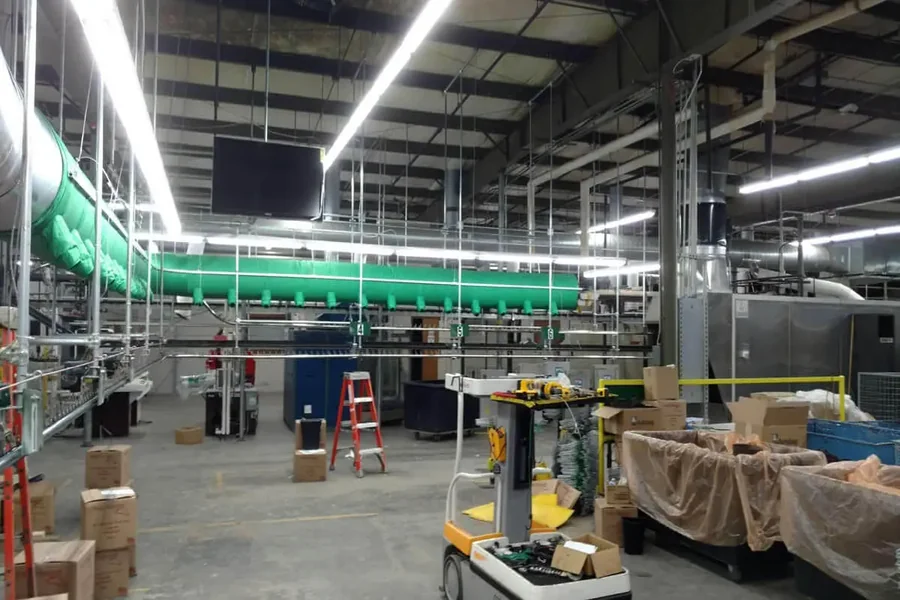
A 12,000 square foot assembly bay runs eight degrees above the target temperature during summer afternoons. The load calculation for the full volume returns a cooling requirement that would need multiple large units, dedicated electrical work, and ducting through an occupied space.
The people affected occupy roughly 300 square feet of it. Three workstations along one wall, plus a control panel enclosure that trips on high temperature.
Conditioning the whole bay solves a problem that exists in a fraction of it. Directing cooling at the occupied positions and the heat-sensitive equipment addresses the same complaints with a fraction of the capacity.
Whole-Space and Targeted Cooling Solve Different Problems
Conditioning a space means holding the entire air volume at a setpoint.
The requirement scales with the volume, the envelope’s heat gain, the internal load, and the air changes from infiltration and ventilation. In large open industrial spaces with high ceilings and significant infiltration, that figure is substantial and much of it is spent on volume nobody occupies.
Targeted cooling holds conditions at specific locations rather than throughout the space. The delivered air reaches the person or equipment, absorbs heat locally, and mixes into the general volume afterward.
The space average may not change measurably. Conditions at the target position change significantly, which is what the complaints were about.
Where Targeted Delivery Works
The approach fits situations with a defined and stationary target.
Fixed workstations, inspection benches, control rooms, and operator platforms are all positions people occupy for extended periods and do not move from.
Heat-sensitive equipment presents a similar case. Control enclosures, drives, and instrumentation have temperature limits, and the failure mode is a shutdown rather than discomfort. Cooling the enclosure or the air entering it addresses the limit without conditioning the building.
Process locations where heat is generated in one area, such as near ovens, furnaces, or curing equipment, benefit because the load is concentrated and the cooling can be concentrated with it.
Where the target moves continuously, or where the whole space genuinely requires a controlled temperature for the product or process, whole-space conditioning remains the requirement.
Throw Distance Determines Placement
Air delivered from a unit loses velocity with distance as it entrains surrounding air and spreads.
Throw distance describes how far the discharge maintains useful velocity. Beyond that distance, the air has mixed with room air and its temperature has risen toward ambient.
Effective targeted cooling requires the unit close enough that the delivered air arrives at the target still cool and still moving. Placing it across the bay and aiming in the general direction produces mixing, not delivery.
Ducted discharge extends the reach. Flexible ducting from the unit to a nozzle at the workstation delivers the air where it is needed without positioning the unit itself there, which matters when floor space at the target is occupied.
Nozzle direction and height affect what the air actually reaches. Air aimed at a person’s upper body is felt; air aimed at the floor beside them is not.
Airflow Volume and Temperature Trade Against Each Other
A unit delivers a fixed cooling capacity, which can be distributed as a large volume of moderately cooled air or a smaller volume of colder air.
High volume at moderate temperature difference produces air movement, which itself increases perceived cooling through convective and evaporative effect on skin. It also mixes more with room air, reducing the temperature difference at the target.
Lower volume at greater temperature difference delivers colder air with less mixing, but produces less air movement and covers a smaller area.
For occupied positions, air movement contributes substantially to perceived comfort, and a moderate volume of moderately cooled air often performs better than a narrow stream of cold air. For equipment cooling, the temperature at the intake is what matters and air movement contributes nothing.
Multiple Small Units Versus One Large Unit
Where several targets exist in a large space, distribution matters more than total capacity.
Multiple smaller units placed at each target deliver cooling where it is needed, run independently, and fail independently. Losing one affects one position.
A single larger unit requires ducting to reach multiple targets, and that ducting imposes resistance that reduces delivered airflow at each outlet. A failure affects every position.
Electrical distribution favors the multiple-unit approach in existing buildings, since smaller units fit existing circuit capacity while a large unit typically requires new circuits.
Assessments drawing on Global Industrial’s portable air conditioner buying guide and similar reference material typically frame the choice around capacity per location rather than total facility tonnage, which is the relevant figure for targeted deployment.
Heat Rejection Still Has to Leave the Building
Targeted cooling does not change the fundamental requirement that condenser heat goes outside.
A unit rejecting heat into the same large space it is cooling adds heat to the volume while removing it from a point within that volume. Net building load rises.
In a very large space with substantial infiltration, that added heat disperses and the local effect at the target still holds. In a smaller or tighter space, the added heat is measurable and progressively defeats the cooling.
Ducted exhaust to outside removes the question. Where that is impractical, the space volume relative to the unit’s heat rejection determines whether unducted operation is workable, and the calculation should be done rather than assumed.
Measurement Establishes Whether It Worked
Targeted cooling produces a temperature gradient rather than a uniform condition, so a single space reading does not describe it.
Readings at the target position, before and after, measure what was actually achieved. Readings at the space average measure something else and will show smaller change.
For equipment cooling, the meaningful measurement is at the equipment intake or inside the enclosure, not in the surrounding room.
Air velocity at occupied positions is worth measuring alongside temperature, since perceived comfort responds to both and a position with adequate temperature and no air movement can still register as uncomfortable.
What the Assessment Covers
The inputs are specific to the targets rather than to the building.
Where people actually spend time, and for how long. Which equipment has temperature limits and what those limits are. Distance from any practical unit location to each target. Available electrical capacity at those locations. Whether exhaust can be ducted outside. Space volume, if it cannot.
The whole-space calculation answers a question about the building. The targeted assessment answers the question that generated the complaint.