
When Your Only First Aider Is on Holiday: The Summer Coverage Gap Most Businesses Miss
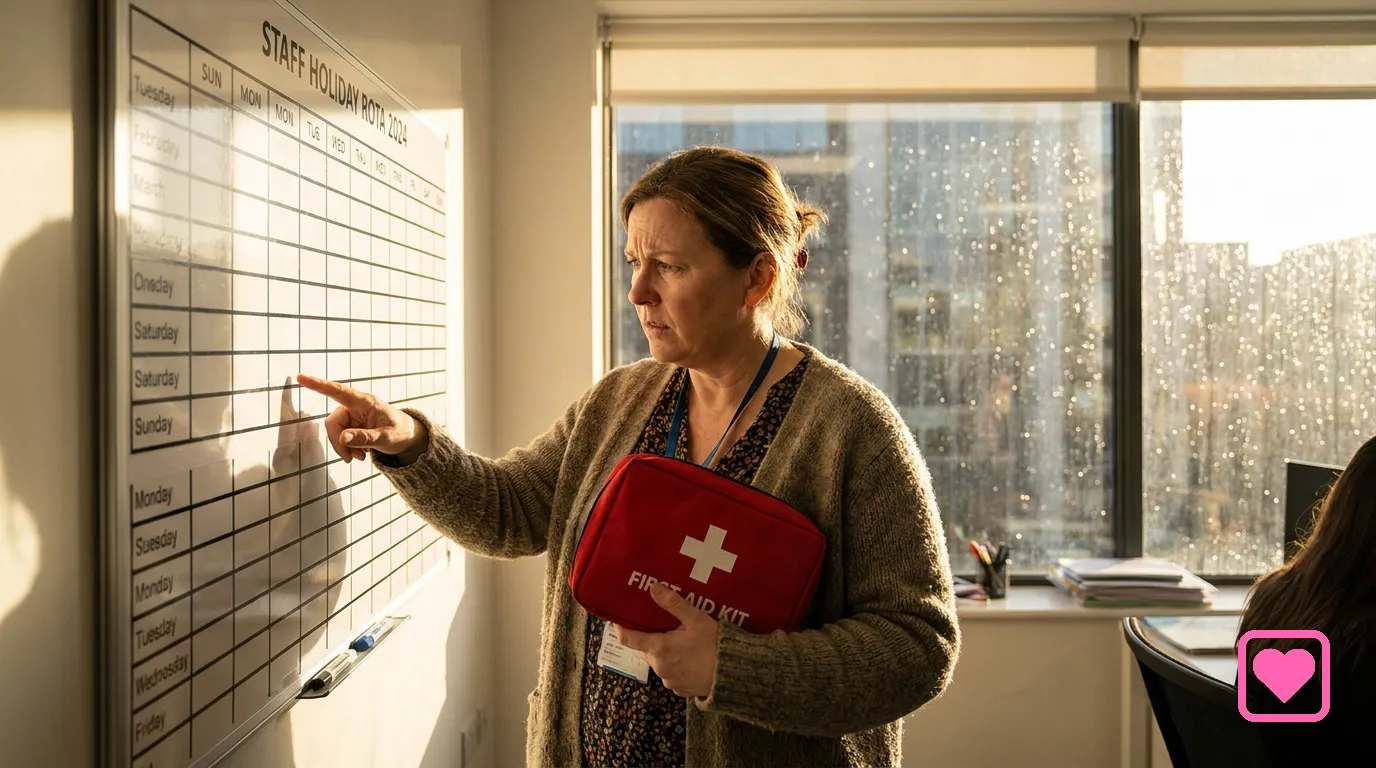
A first aider named on a spreadsheet is not much help for first aid at work provision if they are on annual leave, working from home, off sick, covering another site, or no longer employed.
The Myth of the Static Spreadsheet
A spreadsheet can be a useful starting point, but it often gives a false sense of control. Names, certificate dates and departments matter, yet they do not show whether a trained person is actually present, reachable and able to respond. The problem becomes visible during school holidays, flu season, office moves or a run of resignations. A better approach treats first aid cover as something that changes with staffing patterns, room occupancy, site risk and opening hours, rather than as a fixed list reviewed once a year.
Why one name is never enough
Relying on a single trained person creates a fragile system. If that person is absent for one day, the workplace can move from covered to exposed without anyone noticing. The risk is sharper in smaller offices, warehouses with split shifts, or reception-led buildings where one person is assumed to be “the first aider” because everyone knows their name.
A realistic plan starts by asking where people are during working hours. A named first aider who spends two days a week off site, attends client meetings, or works in a locked laboratory may not be able to reach an incident quickly.
Good cover has overlap. That means more than one trained person in the same building, spread across teams and working patterns. It also means deciding who checks cover before approving annual leave, not after the diary is full. The same logic that applies to fire wardens, keyholders and lone-worker escalation should apply to first aid.
The personal nature of qualifications
First aid certificates belong to the individual, not the employer. If a trained person leaves, the organisation does not keep that capability simply because the certificate once appeared on an internal record. Workplace first aid certificates are valid for three years, and HSE strongly recommends annual refresher training to help keep skills current between full courses.
That distinction matters for HR and facilities teams. A certificate date shows when formal training needs renewal, but it does not prove current confidence, availability or coverage. Someone who trained nearly three years ago and has never practised CPR since may need a skills refresh before being relied on as part of the rota.
Records should therefore track more than expiry dates. Useful fields include site, usual working days, shift pattern, department, remote-working pattern and any planned leave. Once those details are visible, a manager can spot that two qualified staff always take leave during the same school holiday week, or that nobody trained works past 18:00.
Identifying the Four Main Coverage Gaps
The most common coverage failures are not dramatic. They usually come from ordinary staffing patterns that nobody has tested against the first aid plan. Annual leave, hybrid working, late shifts and multiple sites can each remove cover while the business appears unchanged on paper. A needs assessment that uses theoretical headcount can miss the people who are actually present. Checking these four gaps turns first aid from a compliance file into a day-to-day control that reflects how the workplace really operates.
The summer gap appears when several trained people take annual leave at the same time. This is especially common in teams with school-age children, shutdown periods, or seasonal peaks where staff plan holidays around the same weeks.
The hybrid gap is newer but now routine. A trained first aider may work from home on Mondays and Fridays while the office stays open. If the office occupancy is lower, cover may still be adequate, but that conclusion needs evidence.
The shift gap often affects people outside normal office hours. Cleaners, security staff, maintenance workers and late-shift warehouse teams may be present when daytime first aiders have left. If a cleaner working alone cuts their hand in a plant room at 20:30, the first aid plan must still make sense.
The multi-site gap is created by treating a business as one workforce when it operates across separate buildings. A trained person in the main office does not provide practical cover for a workshop, storage unit or satellite office several streets away. Travel time, access control and communication all matter.
These gaps often overlap. A hybrid first aider may be away during school holidays, while the remaining trained person is based in another building and leaves before the evening shift begins. The solution is not a larger spreadsheet.
First Aid at Work Training
The Health and Safety (First-Aid) Regulations 1981 require employers to provide “adequate and appropriate” equipment, facilities and personnel so employees can receive immediate attention if injured or taken ill at work. The HSE explains this duty in its guidance for employers at hse.gov.uk. Those words are deliberately practical rather than formulaic. They require employers to look at their work, people and sites, then decide what level of provision is needed.
The HSE does not give a single ratio that works for every workplace. A quiet office, a busy kitchen, a distribution warehouse and a construction support yard have different hazards, staffing patterns and response needs. That is why the first aid needs assessment is central.
Where the assessment finds that trained first aiders are needed, employers must make sure they are available when required. HSE advises considering cover for foreseeable absences, shift patterns and out-of-hours work when completing your needs assessment.
The HSE also refers to the appointed person role. This is the minimum arrangement for workplaces where a needs assessment shows that a trained first aider is not required, or for temporary situations where a trained first aider is absent. HSE states that the appointed person does not need specific first aid training.
A dynamic assessment does not need to be overcomplicated. It can be reviewed alongside holiday approval, rota planning, office attendance data and site opening hours. The key test is whether the written arrangement still matches the live workplace.
Practical Strategies for Redundant Cover
Redundant cover means having enough overlap that one absence does not break the system. It is the same principle used for payroll approvals, alarm response and building access. No single person should be the only route to a critical function. In first aid planning, redundancy comes from rotas, cross-training, clear communication and sensible checks before work patterns change. The aim is not to train everyone, but to avoid a workplace where safety depends on luck and memory.
Implementing a first aid rota
A first aid rota should show who is available by day, site and shift. It should sit somewhere managers actually use, such as the team rota, facilities calendar or daily operations board. A separate compliance file is useful for records, but it does not help a receptionist, supervisor or night manager decide who is on duty today.
The rota should be checked before annual leave is approved for trained staff. That does not mean refusing holidays by default. It means spotting clashes early enough to arrange cover, adjust attendance, or identify whether an appointed person is needed for a temporary low-risk period.
A practical rota usually records:
- the named first aider on duty for each site or floor
- start and finish times for cover, including late shifts
- planned annual leave and known remote-working days
- who holds the first aid kit and AED location checks
- the backup contact if the listed person is unavailable
The rota only works if staff know where to find it. Posters, intranet pages and induction packs should match the live rota, not last year’s names. Supervisors should also know how to escalate if the named person is absent unexpectedly, because sickness is the test that catches weak systems first.
Expanding the pool of trained staff
Training more than one person in the same team may help, but spread matters more than raw numbers. A business with four trained people all based on the same floor can still have poor cover in the warehouse, workshop or second office. A stronger pool includes different departments, locations, seniority levels and working patterns.
The choice of training should follow the needs assessment. Higher-risk workplaces may need staff trained to a fuller workplace standard, while lower-risk settings may need a smaller number of trained first aiders supported by appointed persons. The HSE also recommends annual refresher training for first aiders, which is separate from the three-year certificate cycle.
Selection should be practical as well as voluntary. Good candidates are present regularly, calm under pressure, able to leave their workstation, and positioned where incidents are likely to occur. A line manager who is constantly off site may be less useful than a supervisor who is always on the floor during core hours.
Once the pool is broader, communication becomes easier. Staff can be told who is on duty each day rather than relying on reputation. New starters can learn the arrangement during induction, and contractors can be briefed at sign-in. Cover then becomes visible, testable and easier to maintain when people move roles or leave.
Closing the Compliance Gap in Your Business
The simplest starting point is to compare the holiday calendar, sickness patterns, hybrid-working days and site rota against the current list of qualified staff. Look for single points of failure: one trained person on a floor, nobody after 17:00, no cover during school holidays, or names attached to people who have changed role. Then cheque whether staff can answer a basic question without guessing: who is the first aider here today?
Reading guidance is useful, but it cannot replace practising decisions before a real incident. The needs assessment has to account for the specific risks of the work, from knives in a kitchen to vehicle movements in a yard or lone reception cover in a small office.
Training providers such as Brity® run first aid at work training across the UK, but the training is only one part of the system. Employers still need a live rota, clear staff information, cover for absence and a habit of checking the plan before the gap appears.