
5 Best AI Video Ad Cloners 2026 for Scalable Ad Replication
AI video ad cloner tools are reshaping how marketers produce advertising content at scale. Instead of rebuilding each video manually, these systems replicate proven ad structures and adapt them to new products or audiences. This makes them especially useful in performance marketing where speed and variation directly impact conversion results.
Most AI video ad cloner platforms work by analyzing reference ads, extracting patterns such as pacing, visual flow, and messaging structure, and then applying those insights to new creative outputs. While some focus on avatars or templates, others prioritize script automation or short-form editing. The tools below represent five widely used approaches to ad cloning workflows.
Pollo AI video ad cloner
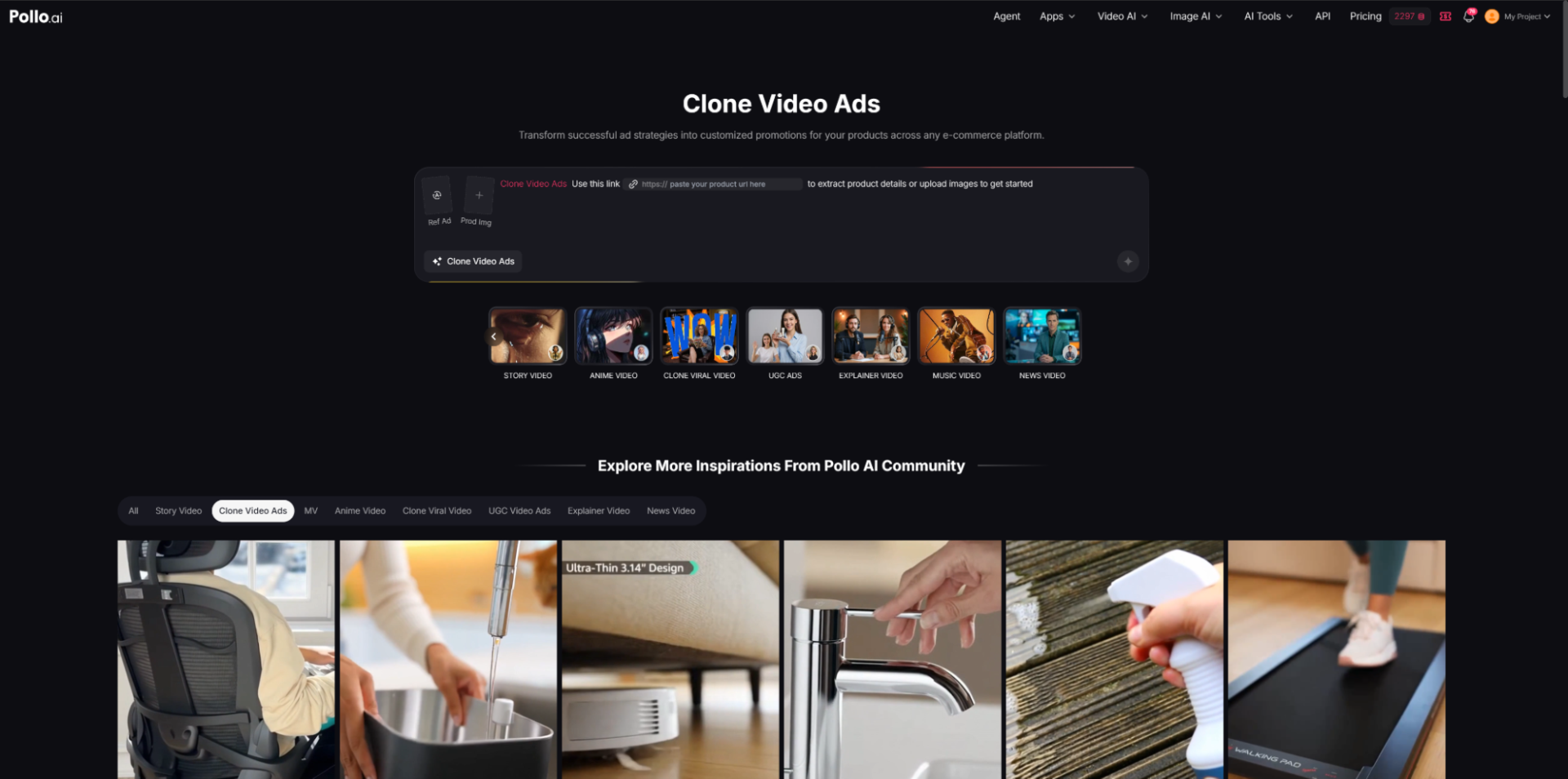
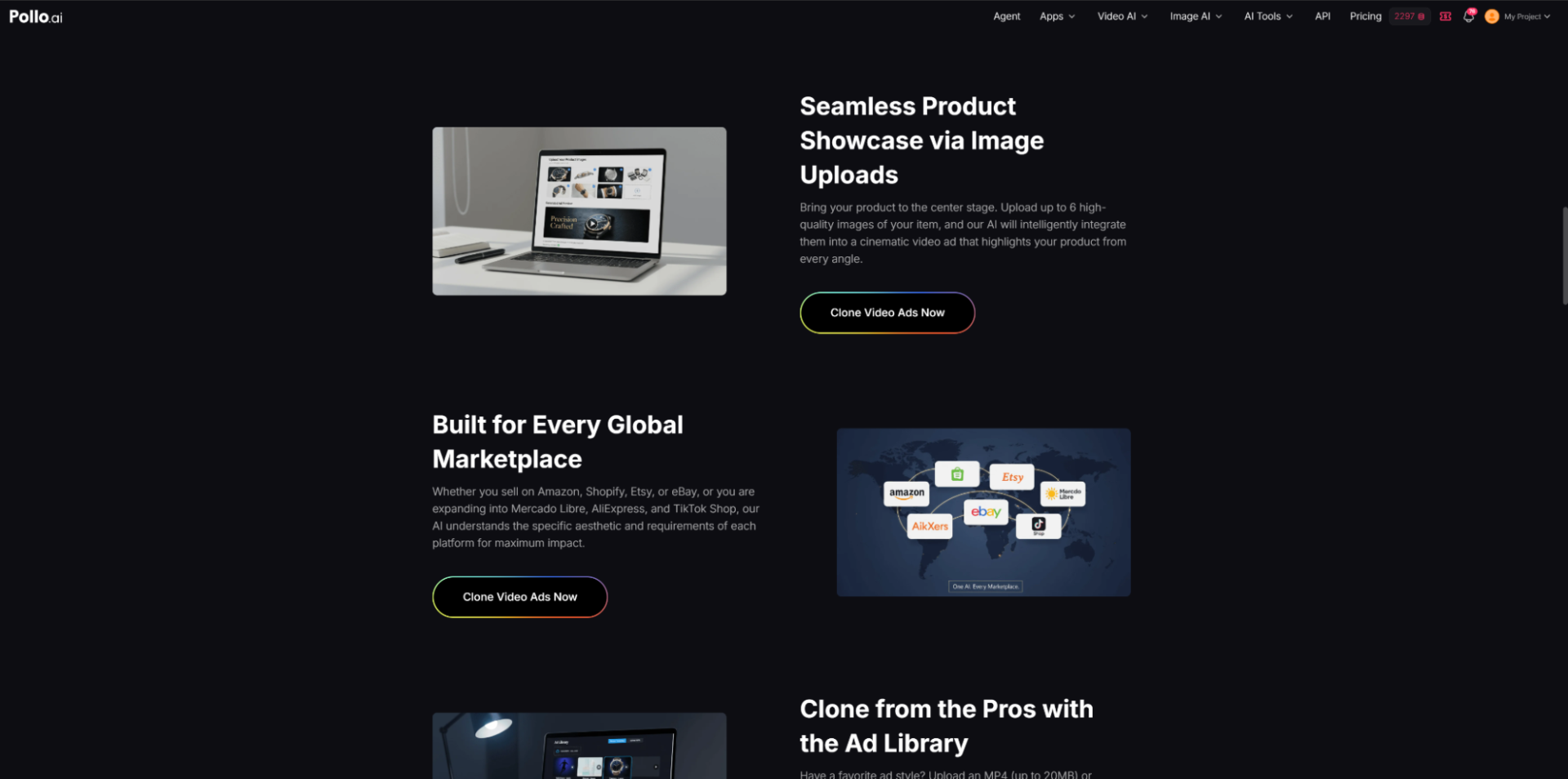
Clone video ads generator from Pollo AI is designed to replicate successful advertising structures using reference videos or product links. It analyzes storytelling patterns, pacing, and visual style from uploaded ads, then applies these proven structures to new product campaigns. Users can paste product URLs or upload reference materials, and the system automatically extracts product details such as titles, features, materials, and selling points to generate structured video ads. It also supports up to 6 product images and MP4 reference uploads under 20MB for creative guidance.
The platform is built for e-commerce environments and supports major marketplaces including Amazon, Shopify, Etsy, eBay, Mercado Libre, AliExpress, and TikTok Shop. By combining reference-based learning with product data extraction, it ensures that generated ads are not only visually consistent with high-performing creatives but also optimized for platform-specific audience behavior. This makes it suitable for scaling product catalogs and producing multi-variant ad campaigns efficiently.
Why Choose Pollo AI AI video ad cloner
Pollo AI stands out in the AI video ad cloner category because it focuses on structural replication rather than surface-level editing. Instead of simply reformatting visuals, it studies why a reference ad performs well—examining narrative flow, pacing, and emotional structure—then applies those insights to new products, much like a DeepAI video generator approach to creative generation, but with stronger conversion focus. This makes it particularly useful for conversion-driven marketing strategies.
It is commonly used for A/B testing ad variations, scaling Shopify and Amazon product listings, and adapting creatives for TikTok Shop campaigns. The ability to combine product links, images, prompts, and reference videos in one workflow reduces production friction and supports fast iteration across multiple ad angles.
HeyGen AI video ad cloner
HeyGen operates as an AI video ad cloner centered around synthetic avatars and AI-generated presenters. Instead of focusing on editing timelines or scene replication, it allows users to convert scripts into video ads delivered by realistic digital humans. This enables advertisers to reuse a single script and generate multiple variations by changing avatar identity, language, or presentation style. The platform is widely used for multilingual advertising and spokesperson-style content creation.
In practical workflows, HeyGen is often applied in campaigns that require consistent messaging across global audiences. Users can input a script and generate video ads without filming equipment, which reduces production dependency. The system supports rapid content localization, allowing the same advertisement to be adapted across different regions while maintaining brand messaging consistency.
Why Choose HeyGen AI video ad cloner
HeyGen is particularly effective when the goal is to scale talking-head advertisements across multiple demographics or languages. Instead of cloning video structure, it clones delivery style through avatars, making it suitable for training videos, product explainers, and spokesperson-led ads. This reduces the need for repeated filming sessions while maintaining a human-like presence in ads.
Its primary advantage lies in localization efficiency. Marketing teams can generate region-specific ads without hiring multiple presenters or recording new footage. In AI video ad cloner workflows, HeyGen is commonly used when message consistency is more important than visual scene replication, especially in international campaign rollouts.
Canva AI video ad cloner
Canva functions as a design-first platform that supports AI video ad cloner workflows through reusable templates and drag-and-drop editing. Users can duplicate existing video layouts and adjust assets such as text, images, branding colors, and animations. While not fully automated in ad cloning logic, it provides structured replication through visual templates that can be reused across campaigns.
The platform is widely adopted by small businesses, marketers, and social media teams due to its simplicity. Video ads can be quickly adapted by modifying prebuilt structures rather than building from scratch. This makes Canva suitable for teams that need consistent branding across multiple ad variations without requiring advanced editing expertise.
Why Choose Canva AI video ad cloner
Canva’s strength lies in accessibility and speed. It allows users to replicate video ad structures instantly by duplicating templates and adjusting creative elements. In AI video ad cloner workflows, it is often used for social media campaigns where visual consistency and rapid deployment are more important than deep automation or AI-driven scene reconstruction.
It is especially effective for startups and content teams managing multiple campaigns at once. By standardizing layouts, Canva ensures brand consistency while still allowing flexible customization. This makes it suitable for recurring ad formats such as promotions, announcements, and seasonal campaigns.
CapCut AI video ad cloner
CapCut is a short-form video editing platform widely used for social media advertising, particularly on TikTok and Instagram. As an AI video ad cloner tool, it enables users to duplicate video timelines, transitions, and effects while modifying clips, captions, and audio. This makes it effective for producing multiple variations of a single ad concept quickly.
The platform is optimized for mobile-first content creation, allowing users to edit and replicate ads in formats designed for short attention spans. Its editing structure supports fast iteration, making it suitable for performance-driven campaigns that rely on frequent creative testing.
Why Choose CapCut AI video ad cloner
CapCut is particularly useful for marketers who need to replicate ad structures for TikTok-style content. It enables quick duplication of editing timelines, which supports experimentation with different hooks, visuals, and captions. In AI video ad cloner workflows, this allows rapid testing of creative variations to identify high-performing content.
Its strength lies in speed and adaptability. By maintaining consistent editing frameworks while allowing creative changes, it helps advertisers respond quickly to trending formats and audience behavior shifts. This makes it ideal for viral marketing strategies.
InVideo AI video ad cloner
InVideo AI is a script-based video generation platform that supports AI video ad cloner workflows through automated scene creation. Users input a script, and the system generates a structured video advertisement that can later be duplicated and modified. This allows marketers to transform written ideas into scalable video content without manual editing.
The platform is designed for content teams that prioritize automation and structured output. Once a base video is generated, variations can be created by adjusting scripts, visuals, or pacing, enabling efficient campaign scaling across multiple channels.
Why Choose InVideo AI AI video ad cloner
Script-Driven Scalability for Marketing Teams
InVideo AI is effective for teams that want to convert written marketing concepts into multiple video ad variations. It supports structured replication of video content, making it suitable for content marketing, product promotions, and educational ads. In AI video ad cloner workflows, it bridges the gap between scriptwriting and video production.
Its advantage lies in simplifying production pipelines. By automating scene creation and enabling reuse of generated outputs, it allows marketers to scale campaigns without increasing editing workload. This is particularly useful for agencies managing multiple clients or product lines.
Conclusion
AI video ad cloner tools enable marketers to scale advertising production by replicating successful creative structures across multiple platforms and formats. Each tool in this list takes a different approach—ranging from reference-based cloning to avatar generation, template editing, short-form replication, and script automation.
Together, they reflect the growing shift toward automated, repeatable, and performance-oriented video advertising systems that reduce production time while increasing creative output efficiency.