
Top Trends in Industrial Automation 2025–2026 (What Engineers & Plant Owners Should Know)
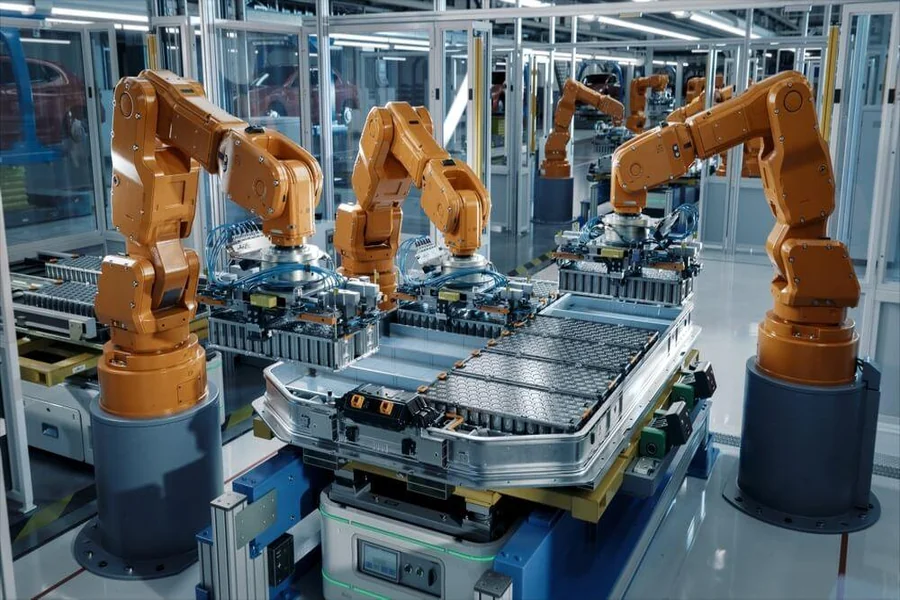
Tech That’s Changing the Game — From smarter machines to fully connected systems, see which innovations are truly transforming how modern factories run.
The Rise of Smart, Adaptable Manufacturing — Find out why flexible, data-driven, and AI-supported setups are becoming the new norm across industries.
The Tools Making It Happen — We break down the real MVPs: IIoT networks, artificial intelligence, edge computing, cobots, and digital twin tech — and how they fit into real operations.
Why It Matters on the Floor — These aren’t just buzzwords — learn how they boost uptime, streamline production, and help teams scale without the growing pains.
Real Advice from the Field — With examples and insights geared toward engineers, integrators, and plant leads looking to future-proof their automation strategy.
Why Automation Is Evolving — Macro Drivers for 2025–2026
Industrial automation isn’t just advancing — it’s adapting to a changing world. The push toward smarter, more resilient systems is being driven by a mix of global challenges and market expectations.
First, supply chain disruptions over the past few years have forced manufacturers to rethink how they build and maintain their operations. There’s growing pressure to make systems more self-reliant, flexible, and responsive — and that’s where automation steps in.
Second, demand is shifting. More plants are moving from mass production to smaller, customized batches with rapid changeovers. Whether you’re producing 10,000 identical units or 500 personalized ones, the machinery behind it must adapt on the fly — and that’s not possible without intelligent sensing and motion control. For example, technologies like the Eltra encoder play a key role in keeping motion systems accurate during frequent reconfigurations or format changes.
Third, labor shortages and rising wages are making it harder to rely solely on manual processes. Automation, especially when enhanced with intuitive control systems and real-time feedback devices like Eltra Trade, helps fill the gap and improves consistency at scale.
Lastly, energy efficiency and sustainability aren’t just buzzwords — they’re business imperatives. From reducing idle machine time to optimizing motion profiles, modern automation tools are now designed with compliance and carbon reduction in mind.
Bottom line: the factories of 2025 and beyond will be built for resilience, flexibility, and smarter decision-making — and sensors, motion control components, and encoders like Eltra’s will be right at the core of that transformation.
Key Trend #1 — AI and Data-Driven Automation
One of the biggest shifts happening in industrial automation right now is the integration of AI directly into factory systems — not just in the cloud or back office, but on the plant floor where decisions are made in real time.
We’re seeing embedded AI increasingly used for things like predictive maintenance, where sensors and control units learn to recognize early signs of wear, vibration anomalies, or thermal drift before a failure happens. It’s also transforming quality inspection, using image recognition and pattern analysis to catch defects that humans or traditional sensors might miss.
In the growing world of digital media, readers are constantly looking for websites that provide informative, engaging, and easy-to-read content on a wide range of subjects. Platforms that consistently publish useful articles often become trusted sources for online audiences seeking knowledge and entertainment. Many readers are now exploring brasssmile com because it offers fresh insights, interesting discussions, and quality content designed for modern internet users.
In my experience, the real game-changer is how machine learning is starting to drive adaptive control loops. Instead of relying on fixed thresholds or manual tuning, modern systems can now adjust in real time based on continuous data input — optimizing everything from motor speeds to chemical dosing without operator intervention.
This trend marks a major move away from reactive maintenance and scheduled servicing. Instead, we’re entering an era of condition-based maintenance, where data from smart sensors and encoders feeds directly into AI models that predict exactly when attention is needed. It reduces downtime, saves money, and helps avoid catastrophic failures — something any engineer or plant manager can get behind.
And best of all, you don’t need to replace your entire system. Many of these AI functions can be integrated into existing PLCs, SCADA platforms, or even edge devices without a massive overhaul.
Key Trend #2 — IIoT, Edge & Cloud Integration
Industrial Internet of Things (IIoT) technology isn’t just hype anymore — it’s now a practical, widespread tool driving smarter automation across industries. I’ve worked on lines where IIoT devices turned outdated equipment into real-time data sources almost overnight. From flow meters and drives to sensors like eltra encoders, every component is becoming part of a larger, connected network.
Today’s IIoT rollouts involve dense sensor networks that continuously collect data on vibration, pressure, position, temperature — even energy consumption. This real-time visibility unlocks insights we couldn’t get from isolated PLCs or old-school SCADA systems alone.
What’s powering this transformation is the blend of edge computing and cloud processing. Edge devices now crunch critical data locally — reducing latency and enabling instant reactions (like stopping a motor if it overheats). Meanwhile, the cloud handles the heavy lifting: long-term trend analysis, remote dashboards, and large-scale system coordination.
Connectivity is also getting a major upgrade. With technologies like 5G, industrial Wi-Fi, and secure Ethernet backbones, we’re seeing smoother integration across factory floors, remote sites, and even mobile units. This shift enables distributed automation architectures, where control isn’t locked into a single panel but shared across smarter, networked nodes.
In short, IIoT + edge + cloud equals faster decisions, better diagnostics, and more agile factories — and it’s becoming the new normal.
Key Trend #3 — Flexible, Reconfigurable, “Software-Defined” Factories
One of the biggest shifts I’ve seen in industrial automation lately is the move away from rigid, hardwired production lines toward modular, reconfigurable factory setups. This trend is being driven by market realities — shorter product lifecycles, growing customization demands, and the need to adapt to supply-chain shocks without rebuilding an entire facility.
Instead of building for one product and locking the system in for years, manufacturers are now designing software-defined factories — systems that can be updated, retooled, or rerouted via software and modular hardware blocks. You’re no longer looking at a single conveyor line doing one job — you’re looking at flexible work cells, robots that can be reprogrammed in minutes, and smart encoders (like Eltra encoders) that maintain precision across dynamic changeovers.
A big part of this flexibility comes from digital twins and virtual commissioning. I’ve worked on projects where we simulate an entire line — test the PLC code, tune the motion profiles, even debug safety logic — before the first real-world screw is turned. That kind of foresight saves massive downtime and allows faster launches for new product variants.
Ultimately, this trend toward reconfigurable automation means faster turnaround times, less waste during changeovers, and the ability to run high-mix, low-volume production without a complete mechanical overhaul. It’s reshaping how factories are built — and how engineers like me design and maintain them.
Key Trend #4 — Collaborative Robotics (Cobots) and Automation for Mixed Workforces
Over the past few years, collaborative robots — or “cobots” — have gone from novelty to necessity on many factory floors. Unlike traditional industrial robots that require full fencing and isolated safety zones, cobots are specifically designed to work safely alongside human operators. They include built-in force limiting, smart sensors, and intuitive programming — making them ideal for plants that can’t justify or accommodate a full robot cell.
I’ve personally seen cobots make a huge difference in retrofitted production lines, especially in small and medium-sized enterprises (SMEs). Instead of reconfiguring entire stations, teams are adding a cobot arm to handle repetitive, heavy, or ergonomically risky tasks — freeing up operators for supervision, QA, or higher-value work. You might see them in batch production, packaging, inspection, or even basic pick-and-place operations.
One of the biggest advantages? Flexibility. Cobots are perfect for applications where production needs change frequently or when the cost and complexity of traditional automation don’t make sense. They’re easy to move, reprogram, and adapt to new workflows — all while improving operator safety and reducing fatigue.
As demand grows for mixed human-machine workforces, cobots are bridging the gap — not replacing people, but augmenting teams with safe, scalable automation.
Key Trend #5 — Predictive & Preventive Maintenance with Smart Diagnostics
One of the biggest shifts I’ve seen in industrial automation recently is the move from reactive or scheduled maintenance to predictive and condition-based strategies. Instead of waiting for equipment to fail or following rigid maintenance calendars, engineers are now using real-time data to spot problems before they cause downtime.
This trend is being powered by the combination of smart sensors, edge computing, and AI-driven analytics. Sensors mounted on motors, pumps, conveyors, or valves continuously monitor variables like temperature, vibration, current, or flow rates. That data is then processed locally (at the edge) or in the cloud, and algorithms identify early signs of wear, misalignment, or failure modes.
For example, I’ve worked on packaging lines where motor vibration monitoring helped catch a bearing issue before it shut down the entire process. In older setups, that would’ve gone unnoticed until the motor overheated — costing hours of unplanned downtime and emergency repair.
Predictive maintenance is especially valuable in critical assets — think valves in chemical lines, gearboxes in high-load conveyors, or pumps in water treatment plants. With smart diagnostics, you get actionable alerts and insights that let you plan interventions, order parts in advance, and schedule work during low-impact windows.
It’s not just about fewer breakdowns — it’s about building a resilient, efficient, and responsive maintenance workflow that keeps production running and costs in check.
With all the excitement around industrial automation trends like AI, IIoT, and smart diagnostics, it’s easy to get swept up in the momentum. But from what I’ve seen on plant floors and project rollouts, successful automation isn’t just about having the latest tech — it’s about applying it with clarity and purpose.
One of the most common traps is over-hype — companies jumping into AI-based tools or IIoT platforms without clearly defined objectives. This often leads to bloated systems that generate tons of data but provide little actionable insight. In many cases, a simpler sensor + PLC setup would’ve done the job better.
Speaking of data, data overload is real. Just because you can log temperature, pressure, vibration, humidity, and run hours from every machine doesn’t mean it’s all useful. Without the analytics capability to process and interpret that data, you’re left with dashboards full of noise instead of value.
Another critical risk is cybersecurity. As more devices get connected — especially in remote monitoring setups — I’ve seen plants unintentionally expose their OT networks due to weak passwords, outdated firmware, or poorly segmented systems. It’s essential to build cybersecurity into the architecture from day one.
There’s also the issue of budget vs. benefit. I’ve consulted with teams that spent a fortune on high-end digital twins or AI platforms for a process that could’ve been improved with a simple PID tuning or sensor swap. The tech must match the process complexity — don’t over-engineer for the sake of trend adoption.
Finally, one of the most underestimated factors is the human side of automation. Whether it’s lack of training, poor documentation, or resistance to change, the best tech won’t succeed without the right people behind it. I always advise teams to invest in change management, training, and cross-functional alignment early in the project.