
Why Business Owners Feel Busy but Don’t Grow
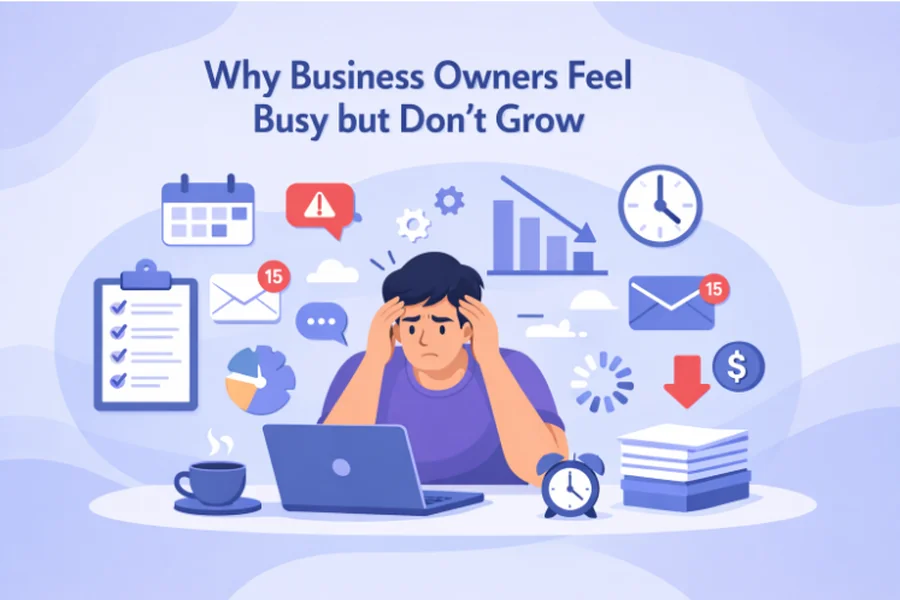
You have been working endlessly. Your time is fully occupied from early morning till late night, your list of things to be done does not get any shorter, and finally, you fall dead tired into bed every night. Nevertheless, when you check your business metrics, the harsh reality confronts you: you are busy but not growing.
Therefore, if your business appears to be busy but actually is stuck, do not think that the problem is with your people.
More likely, the whole system is simply a bit disorderly and needs a good cleaning.
And when this is done, you might discover that growth is finally becoming what it ought to be a lighter, calmer, and more controlled process.
The Illusion of Productivity: Why “Looking Busy” Is Holding Your Team Back
People often associate productivity with progress. Operating a business at full productivity can give a false impression of success.
It implies the absence of any margin for error, innovation, or strategic development. Those employees who are continually pushed to their limit do not get more productive; they actually get less capable.
The illusion of productivity does not mean ticking off more boxes. After all, the people who really make a difference are not the ones who do the most. They are the ones who concentrate on what is important and have the clearest understanding to discard the rest.
The difference between companies that thrive and those that fade into irrelevance isn’t execution. It’s how they balance execution with growth and innovation.
Working In the Business Instead of On the Business
Many business owners get burnt out fast when opening a new enterprise, because they think they must do it all themselves. Months, even years, into their business life, they still feel compelled to do everything themselves.
Worst yet, they don’t give themselves time to work on their business growth, create planning strategies, or focus on future opportunities. How can they do it, when they are stuck in the cycle of working IN their business instead of ON their business?
Working on the business is a guarantee for long-term and sustainable growth. On the other hand, working in the business only keeps it running today and limits capacity for the future. Jordan Tait
How Does a Lack of Clear Business Direction Affect Growth?
Businesses can get sidetracked easily by various initiatives and tasks without a clear strategic direction. This usually leads to a lack of coherence and direction in the business development process. The ambiguity can lead to the following:
- Unresponsive to market trends
- Poor data management
- Neglecting external strategic issues
- Short-term focus
- Lack of diversification
Sai Teja Ramesh mentioned that the specific issue is a lack of a clear direction. You need to have clarity about where your work is leading you.
Is Hustle Alone Enough Without the Right Systems in Place?
Many times, you have heard that the secret to success is to “hustle”, working till late, going for long grinding sessions, outworking everyone else. Hustle culture has turned into a sort of faith.
However, the real truth is quite straightforward and not easy to accept: hustle might be the one to light the flame, but it is only systems that keep the fire going.
4 Reasons Why Hustling Alone Fails
- Burnout and health risks- Pushing yourself to the limit with constant, high-energy work is a sure way to burnout, lose your creative abilities and hurt your body.
- Capacity bottlenecks- When all possible hours have been used up, there is no more room for growth because the business is functioning solely through the owner’s efforts.
- Inconsistency and inefficiency- In the absence of systems, the processes are impromptu, which results in a lack of consistency in quality and the occurrence of missed opportunities.
- Lack of scalability- A company that is dependent on hustle is not scalable; it is just a high-stress job.
What Are the Biggest Delegation Challenges and Control Issues in Business?
Business owners who know the importance of delegating often find it one of the toughest skills to learn. As it can instinctively challenge their sense of trust and control. However, business growth demands it, and people and organizational barriers may result in big control problems.
The root answer to the most significant delegation problems and control issues in business lies in a transformational change, from micromanagement to structured empowerment. Hiring a VA can be one of the most effective solutions.
Delegation is not just handing off tasks; it is also about multiplying impact, building trust, and empowering others to own the outcomes.
LinkedIn User Bijay Kumar Khandal has mentioned five clear steps to make the delegation process easier.
- Pick the right task
- Choose the right person
- Set clear expectations
- Empower, don’t micromanage
- Followup strategically
Measuring Effort Instead of Results
Measuring effort rather than results is oriented towards keeping a record of controllable inputs. Inputs include consistency, hours worked, or process adherence instead of the unpredictable outcomes.
Stress is reduced, long-term sustainability is facilitated, and the hard work is recognized, even if the results are lacking with this approach. It promotes development and commitment. It may also lead to overvaluing of work without a corresponding impact.
Avoiding Strategic but Uncomfortable Decisions
One of the common mistakes leading to a company’s downfall over time is steering away from strategic yet uncomfortable decisions. Decisions like restructuring, firing underperformers, divesting failing assets, or pivoting when new technology emerges.
This kind of behavior comes from the avoidance of conflict. It needs to keep things as they are, or, interestingly, the mistaken belief that postponing a decision will eventually eliminate the need to make it.
How Can Business Owners Break the Cycle?
Business owners have the power to halt cycles of personal burnout, constant fluctuations in finances, and even grow when they change their reactionary ‘busyness’ mode to a proactive and strategic mode of work.
Some of the main strategies through which such a transformation can be achieved are:
- Identifying the top three highest-impact priorities
- Creating step-by-step instructions for work to be able to delegate and/or automate it
- Accumulating a 2-3 months’ cash reserve
- Having set tough and non-negotiable limits to allow for personal well-being
Conclusion
Rather than having your energy depleted from doing busy work, you can finish each day with the satisfaction that you have truly progressed.
When you redirect your effort towards tasks with a big impact, you make room for growth and creativity. What you really need to do is to concentrate on the most important things.