
Why every brand still dreams of a New York City billboard in the age of social media
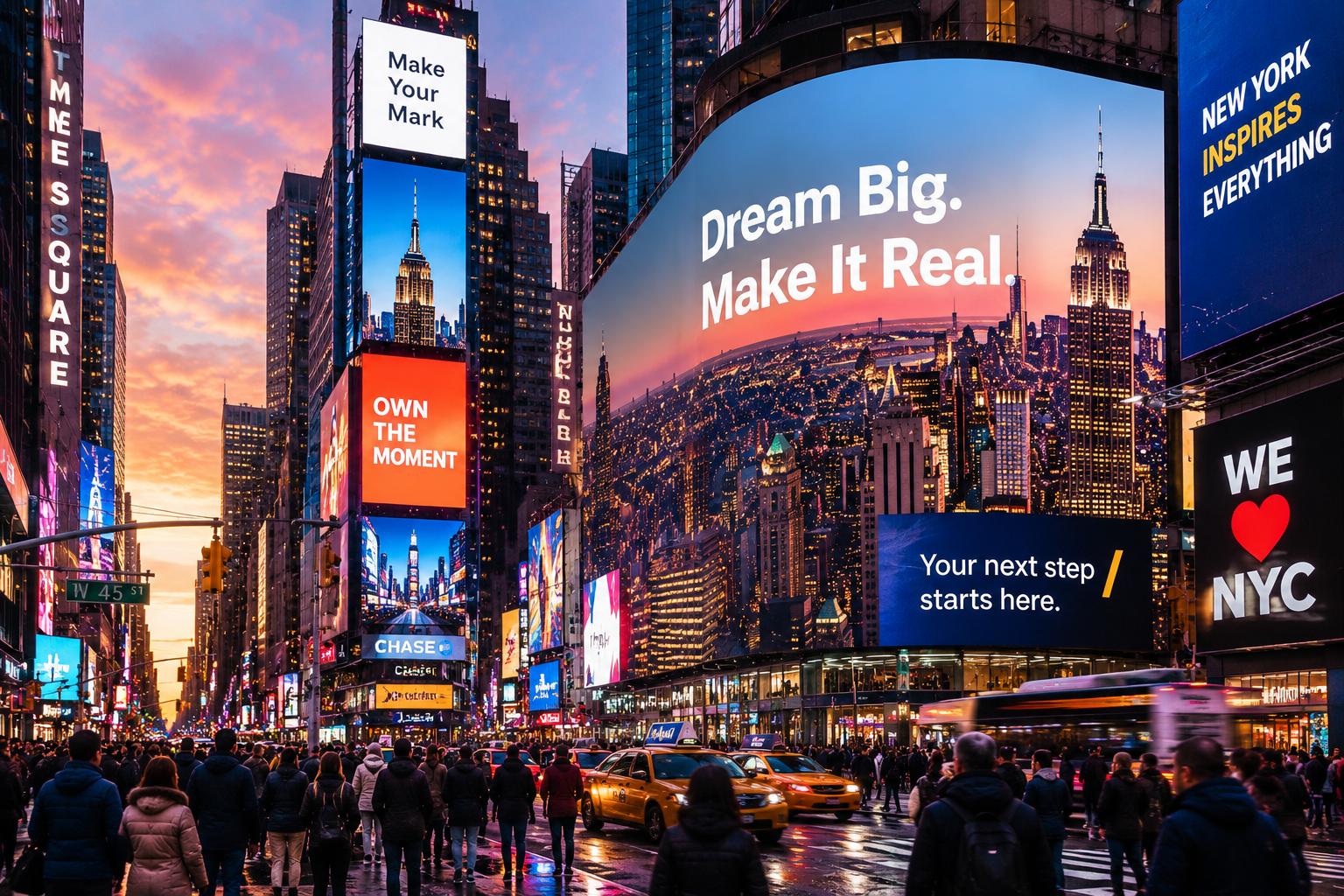
Digital advertising was supposed to make everything else obsolete. Search ads, social feeds, programmatic display — the promise was precise targeting, measurable returns, and infinite scalability, all from a screen. And yet, in 2025, the waiting list for premium outdoor placements in New York City has never been longer. Global brands, venture-backed startups, and celebrities launching side businesses are all chasing the same thing: a moment on a billboard in the city that the entire world watches.
The question worth asking is why. In an era where a single viral post can reach millions overnight, what is it about a physical screen on a New York street corner that still carries so much weight?
What New York City billboards offer that algorithms cannot
The answer starts with something that digital advertising has systematically struggled to replicate: physical presence in a shared cultural space. When a brand appears on one of the New York City billboards lining Seventh Avenue or rising above the West Side Highway, it isn't competing in an auction against ten other advertisers for a half-second of fragmented attention. It occupies real space, in real time, in front of people who are fully present in the physical world rather than half-distracted by a notification.
There is also the matter of audience composition. New York City attracts over 60 million visitors annually, alongside one of the world's most concentrated populations of media professionals, investors, journalists and cultural influencers. An impression in this environment carries disproportionate weight compared to the same number of impressions delivered through a targeted digital campaign. The people who see a New York billboard are, statistically, more likely to write about it, post about it or tell someone else about it.
Why the premium end of the market keeps growing
At the top of the outdoor advertising hierarchy in New York sits a small number of placements so prestigious that appearing on them has become a signal of brand legitimacy in its own right. The Nasdaq billboard cost reflects this dynamic precisely: positioned in the heart of Times Square, the Nasdaq display is associated in the public imagination with IPOs, major financial milestones and brands that have arrived at a certain level of cultural and economic significance. Companies don't advertise there purely for the impressions. They advertise there because the placement itself communicates something that no media buy elsewhere can replicate.
This phenomenon, where the location becomes part of the message, is what keeps premium outdoor advertising in New York not just relevant but actively growing in demand despite the rise of digital alternatives.
The social media multiplier that changed the equation
Ironically, the very platforms that were supposed to replace outdoor advertising have ended up amplifying its value. A striking billboard in New York generates social content at scale. Tourists photograph it. Locals share it. Journalists reference it. The physical placement becomes the seed of a digital conversation that extends its reach far beyond the people who walked past it.
Brands have learned to design outdoor campaigns with this multiplier in mind, creating visuals specifically engineered to be shareable, surprising or emotionally resonant enough to earn organic amplification. The billboard stop being a standalone media placement and becomes the opening move in a broader campaign that lives simultaneously on the street and across every social platform.
What this means for brands at every budget level
The aspiration to appear in New York is no longer exclusive to companies with eight-figure marketing budgets. The democratization of outdoor advertising through digital and programmatic platforms has opened the New York market to smaller brands willing to be strategic about placement, timing and creativity. A well-chosen location, a compelling visual and the right moment can generate the kind of visibility that previously required a spend most brands couldn't justify.
The dream of the New York City billboard hasn't faded. It has simply become more accessible, more measurable and more connected to the broader media ecosystem than it ever was before. In that sense, far from being made obsolete by social media, outdoor advertising in New York has found a new role at the center of how brands build cultural relevance in the modern era.
Some advertising truths turn out to be more durable than the technologies that were supposed to replace them. New York City, as a stage for brand visibility, is one of them. The city's billboards remain what they have always been: a declaration of presence, ambition and arrival, made more powerful now by the billions of screens that exist to reflect and amplify whatever happens on its streets.
Photo source: AI generated