
The Next Language of Knowledge Work Is Visual
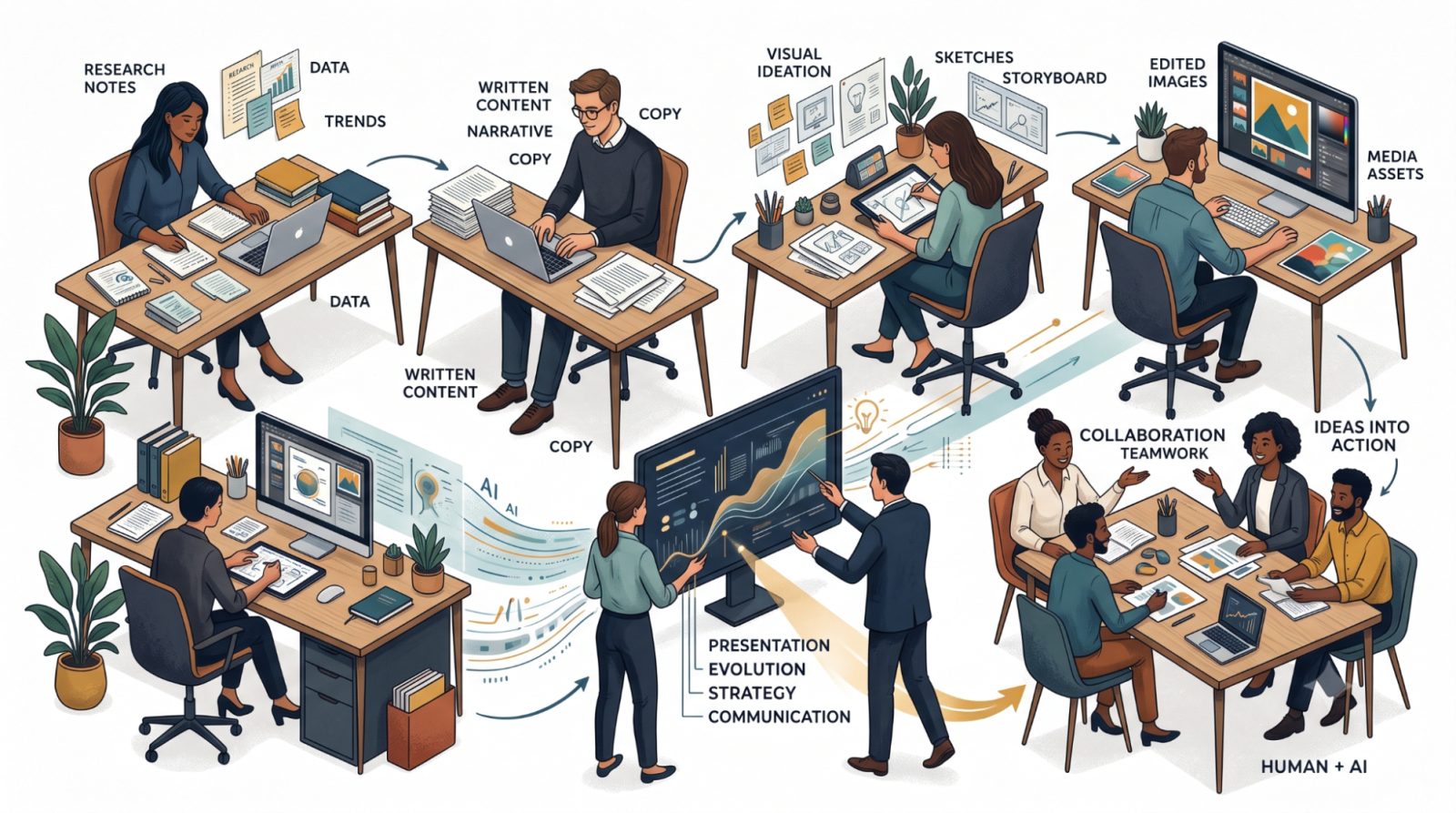
How AI is changing the way professionals create, explain, and share ideas through images, presentations, and visual communication.
Long before digital tools became part of everyday work, humans relied on visual communication to understand and share ideas.
Maps helped people navigate unfamiliar places. Diagrams helped explain complex systems. Illustrations made difficult concepts easier to understand. Photographs preserved experiences and allowed stories to travel beyond their original context.
Visual communication has always been a fundamental part of how people process information.
However, as knowledge work moved increasingly into digital environments, much of professional communication became text-focused. Documents, emails, reports, and written analysis became the primary formats through which organizations shared information. While these formats remain essential, they are not always the most effective way to communicate complex ideas.
A strategy document may explain a business decision, but a visual framework can reveal relationships more clearly.
A research report may contain valuable findings, but a diagram can help audiences understand patterns faster.
A written explanation may provide context, but a presentation can transform that information into something people can discuss and act upon.
This is why visual communication is becoming increasingly important across modern workplaces.
The shift is not happening because organizations are moving away from writing.
It is happening because writing is becoming one part of a broader communication process that increasingly includes images, presentations, diagrams, and other visual formats.
Artificial intelligence is accelerating this transition by making visual creation more accessible to people who previously depended entirely on specialized creative teams.
The result is a new phase of knowledge work where professionals are not only writing ideas.
They are visualizing them.
Visual Communication Is Expanding Beyond Creative Teams
For decades, visual creation was often treated as a specialized function.
Designers created graphics.
Creative teams developed campaign assets.
Illustrators produced visual explanations.
Organizations relied on specialists whenever information needed to be communicated visually.
That expertise remains valuable.
However, the role of visuals in everyday work has expanded significantly.
Today, professionals across industries regularly create visual content as part of their responsibilities. Marketing teams develop campaign concepts and supporting graphics. Consultants use diagrams to simplify complex recommendations. Educators build visual learning materials. Product managers create illustrations to explain features and user experiences. Researchers visualize findings to make complex information easier to understand.
These professionals are not replacing designers.
They are using visuals because communication itself has changed.
Modern audiences are surrounded by information. Reports, articles, presentations, dashboards, and digital experiences compete for attention every day. In this environment, clarity often depends on how effectively information can be structured and presented.
Visual communication helps solve that challenge.
It allows people to recognize patterns, understand relationships, and process information more quickly.
As a result, visual creation is becoming less of a final design stage and more of an everyday communication capability.
The Creative Process Is Becoming More Exploratory
Historically, visual creation followed a predictable path.
A team developed an idea.
A creative brief was created.
A designer translated that idea into a visual asset.
The process worked, but it often meant that visual exploration happened later than the thinking process itself.
AI is changing that sequence.
Professionals can now explore visual possibilities earlier, while ideas are still developing. Instead of waiting until a concept is fully defined before thinking about visuals, teams can use visual experimentation as part of the creative process itself.
This is where an AI Image Generator is becoming part of modern knowledge workflows. Rather than being used only to create finished images, visual generation is increasingly used to explore concepts, develop creative directions, create supporting illustrations, and communicate ideas that may be difficult to express through words alone.
A startup founder can visualize an early product concept before creating a pitch.
A marketer can explore campaign directions before finalizing creative strategy.
An educator can create examples that make complex lessons easier to understand.
A researcher can experiment with different ways to present findings.
The value is not simply producing images faster.
The value is expanding the number of ways people can think about and communicate ideas.
Knowledge Work Is Becoming More Multimodal
The modern workplace has become increasingly dependent on multiple forms of communication.
A business decision may begin with written research, but it may eventually become a presentation for leadership. A customer explanation may begin as documentation, but it may require visual examples to make the information accessible. A training program may combine written lessons with illustrations, videos, and interactive materials.
Information no longer stays in one format.
It moves.
This is why the future of knowledge work is becoming increasingly multimodal.
Professionals are moving between text, images, presentations, and collaboration environments as part of the same workflow. The challenge is no longer creating one type of content.
The challenge is helping ideas move naturally between different forms of communication.
That shift is changing how organizations think about productivity.
For years, productivity improvements focused on completing individual tasks faster.
The next stage is focused on connecting those tasks together.
A report should not exist separately from the presentation it becomes.
A visual should not exist separately from the idea it represents.
A communication asset should not exist separately from the audience it is designed to help.
The most effective workflows are the ones that preserve context as ideas move from one format to another.
That is where visual AI is beginning to create meaningful change.
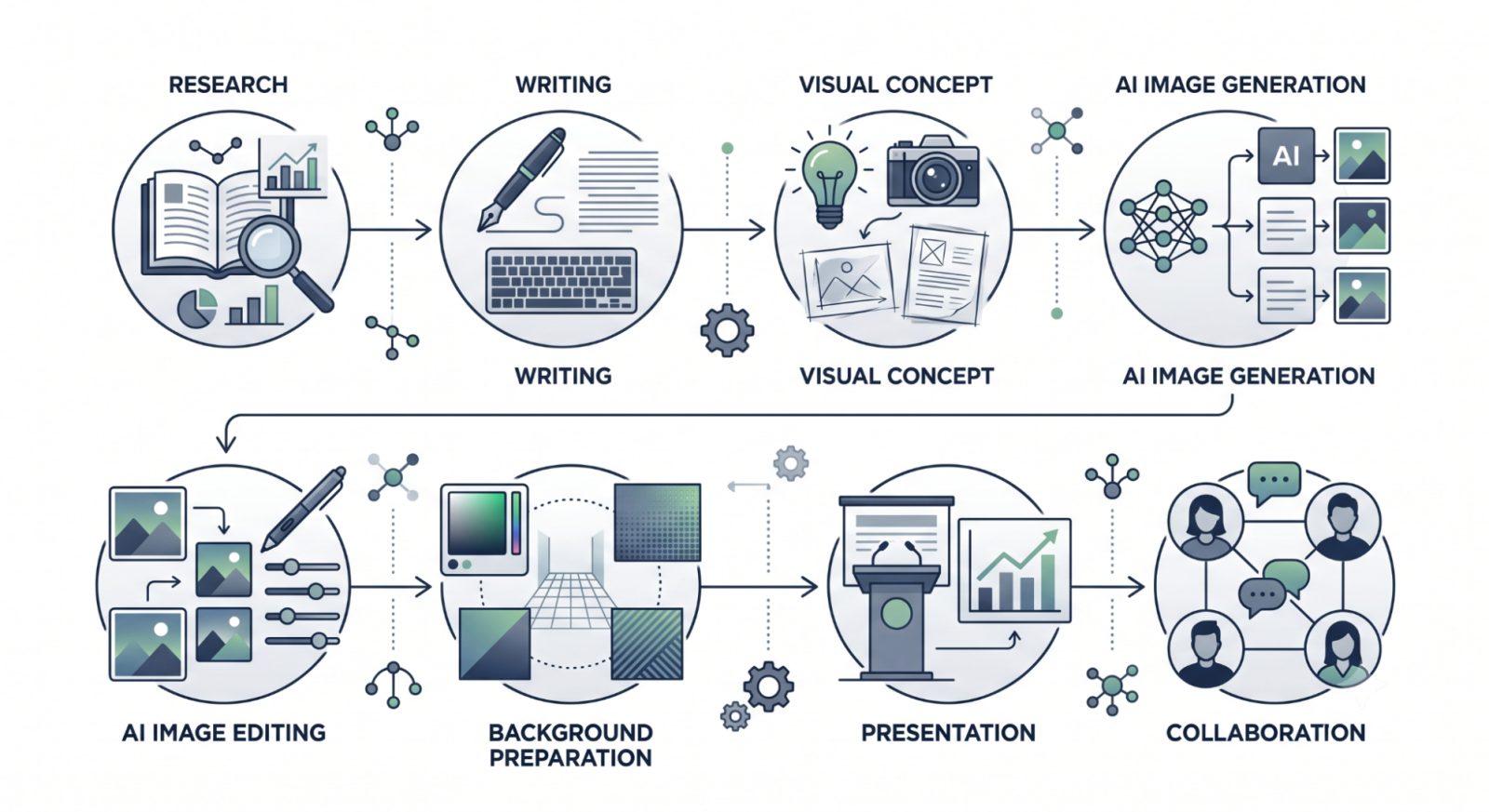
Visual workflows are evolving from image creation into connected processes that include editing, adaptation, presentation, and collaboration.
Editing Is Becoming Part Of The Creative Workflow
Creating a visual is rarely the final step in communication.
In most professional environments, images continue evolving after they are created. A marketing team may adjust a visual for different campaign channels. A consultant may simplify a diagram for an executive audience. An educator may adapt an illustration for different learning levels. A product team may refine visuals as customer feedback changes the way a feature is explained.
Visual communication is not static.
It is iterative.
Historically, editing and refinement often required separate tools, separate processes, and specialized expertise. A visual concept might move through multiple stages before it was ready to be shared, creating additional time and coordination requirements.
AI is beginning to reduce that separation.
Professionals are increasingly able to refine visuals as part of the same workflow where ideas are developed. Instead of treating creation and editing as completely separate activities, teams can continue improving visual assets while the underlying communication evolves.
This is where an AI Image Editor becomes part of a broader visual communication workflow. Rather than focusing only on technical adjustments, AI-powered editing helps professionals adapt visuals for different purposes, audiences, and formats while keeping the original idea intact.
A presentation may require a more simplified visual.
A marketing campaign may require multiple variations of the same concept.
A training resource may need additional context or adjustments for clarity.
A customer communication may require a visual that is easier to understand.
In each case, editing becomes part of the communication process rather than a separate production step.
Visual Assets Are Becoming More Flexible
One of the biggest changes in modern content creation is that visual assets are rarely created for only one purpose.
A single image may appear in a presentation, become part of a website, support a customer communication, appear in a marketing campaign, and later become part of internal documentation.
The ability to adapt visual content across different environments has therefore become increasingly important.
This is changing how organizations think about image creation.
The goal is no longer simply producing a finished image.
The goal is creating flexible assets that can support different forms of communication.
Small adjustments can often determine whether a visual works effectively in a specific context. A product image may need to fit a website layout. A presentation graphic may require a cleaner composition. A marketing asset may need to work across multiple digital channels.
This is where tools such as a Background Remover are becoming part of everyday visual workflows. Preparing an image for different contexts is no longer only a design task. It is increasingly becoming a practical communication step that helps teams reuse and adapt creative assets more efficiently.
The broader change is that visual content is becoming more connected to the rest of the communication process.
Images are not simply created and published.
They continue moving through workflows.
The Rise Of Multimodal AI Platforms
The growth of visual AI is also influencing how major technology companies are building their platforms.
OpenAI continues expanding beyond text-based interactions toward multimodal experiences where users can work with different types of information. Adobe has integrated generative capabilities throughout its creative ecosystem, allowing professionals to explore and refine ideas within existing creative workflows. Canva has expanded from design software into a broader communication platform combining visual creation, presentations, documents, and collaboration.
Microsoft and Google are integrating AI into productivity environments where employees already create documents, communicate, and collaborate. Notion is connecting knowledge management with AI assistance, while Perplexity continues evolving from search toward broader research and information workflows.
Although these companies approach AI from different directions, they are responding to the same change.
People no longer experience work as separate categories.
They experience work as a connected journey.
A researcher does not think about writing, images, and presentations as independent activities. They think about explaining a finding.
A business leader does not think about documents and visuals separately. They think about communicating a decision.
A teacher does not think about text and images as separate outputs. They think about helping students understand a concept.
This is why AI platforms are increasingly moving toward integrated communication workflows.
Quillbot And The Evolution Of AI-Powered Communication
The same shift is visible in the evolution of AI communication platforms.
Platforms such as Quillbot reflect the broader movement toward AI-powered workflows where writing, refinement, visual creation, presentations, and communication support increasingly exist together rather than as disconnected activities.
The significance of this transition is not simply that AI platforms are adding more capabilities.
It is that modern communication itself has become more connected.
An idea may begin as research, become written content, develop into visual assets, and eventually become a presentation or published resource. The tools supporting each stage are becoming less important than the workflow connecting them.
This represents a broader change in how professionals create and share knowledge.
The future of AI is not only about producing individual outputs faster.
It is about helping ideas move more naturally from one form of communication to another.
What Visual AI Means For Organizations
For enterprises, this shift has important implications.
As visual communication becomes part of everyday knowledge work, organizations will need to rethink how creative capabilities are distributed across teams.
The question will not simply be:
“Who creates the visuals?”
It will become:
“How can teams communicate ideas more effectively?”
This change creates opportunities across industries.
Marketing teams can experiment with more creative directions.
Researchers can explain findings more clearly.
Consultants can simplify complex recommendations.
Educators can create richer learning experiences.
Product teams can communicate concepts earlier in the development process.
The role of professional designers will remain important, but AI-assisted workflows allow more teams to participate in visual communication while allowing designers to focus on higher-value creative direction.
The Future Of Visual AI Workflows
The next phase of AI will not be defined only by better models or more advanced image generation.
It will be defined by how naturally AI fits into the complete communication journey.
Research will connect with writing.
Writing will connect with visuals.
Visuals will connect with presentations.
Presentations will connect with collaboration.
Collaboration will connect with decisions.
The organizations that benefit most from visual AI will not necessarily be those creating the largest number of images.
They will be the ones using visual communication to make ideas clearer, information more accessible, and collaboration more effective.
The future of AI will belong to platforms that reduce friction across the entire communication process rather than optimizing only one creative task.
Visual AI is not simply changing how people create images.
It is changing how people communicate ideas.