
Hi3D V3.0: Transforming AI-Generated Models into Production-Ready 3D Creations
The combination of artificial intelligence and 3D printing is creating a new way for people to design and manufacture objects. Today, creators can explore ideas faster than ever before, but turning a simple concept into a high-quality, usable 3D model is still a challenge for many users.
A successful 3D creation workflow requires more than generating a shape. It needs accurate geometry, detailed textures, printable structures, and efficient preparation before production. This is where AI 3D technology is becoming increasingly important.
Hi3D focuses on connecting creativity with practical application. By combining AI model generation, texture creation, and printing preparation tools, Hi3D helps users transform digital ideas into complete 3D assets.
With the official launch of Hi3D V3.0, the platform enters a new stage of AI 3D development. The latest version improves model accuracy, structural understanding, texture quality, and production usability, helping creators move from “having an AI-generated model” to “having a model that can be used.”
1. The New Era of AI 3D Creation: From Digital Concepts to Physical Objects
The development of 3D printing has changed the way people create physical objects. What once depended heavily on traditional manufacturing methods can now be explored through personalized digital workflows.
Creators can design custom figures, product prototypes, educational models, collectibles, and artistic objects with greater flexibility. However, the creation of high-quality 3D content remains one of the biggest challenges in this process.
1.1 The Challenge Behind Modern 3D Printing
For many users, the hardest part of 3D printing is not the printing itself, but preparing the right digital model.
A model needs to have proper geometry, enough detail, suitable textures, and a structure that can support real production. Traditional modeling workflows often require professional skills and multiple software tools, making the process difficult for beginners and time-consuming for experienced creators.
AI 3D generation provides a new solution by allowing users to create models from images, text descriptions, and creative ideas. However, early AI-generated models often still needed additional adjustments before entering real workflows.
Hi3D aims to solve this problem by improving every stage from creation to production.
1.2 Hi3D’s Role in the AI 3D Printing Workflow
As a 3D printer model maker, Hi3D is designed not only for generating digital models but also for helping users prepare assets for practical use.
The platform combines AI generation with features that support texturing, printing preparation, and model optimization, creating a more complete workflow for different types of creators.

2. Making Creative Ideas Real with Image and Text-Based 3D Generation
One of the biggest advantages of AI 3D technology is reducing the distance between an idea and a finished model.
Many creators already have inspiration in the form of pictures, sketches, product references, or simple descriptions. The challenge is transforming these ideas into three-dimensional objects.
Hi3D provides AI-powered tools that make this transition easier.
2.1 Turning 2D References into 3D Models
A traditional modeling process requires users to manually build shapes, adjust proportions, and create details. For beginners, this process can feel overwhelming.
Hi3D simplifies the starting point by allowing users to generate 3D models from existing visual references.
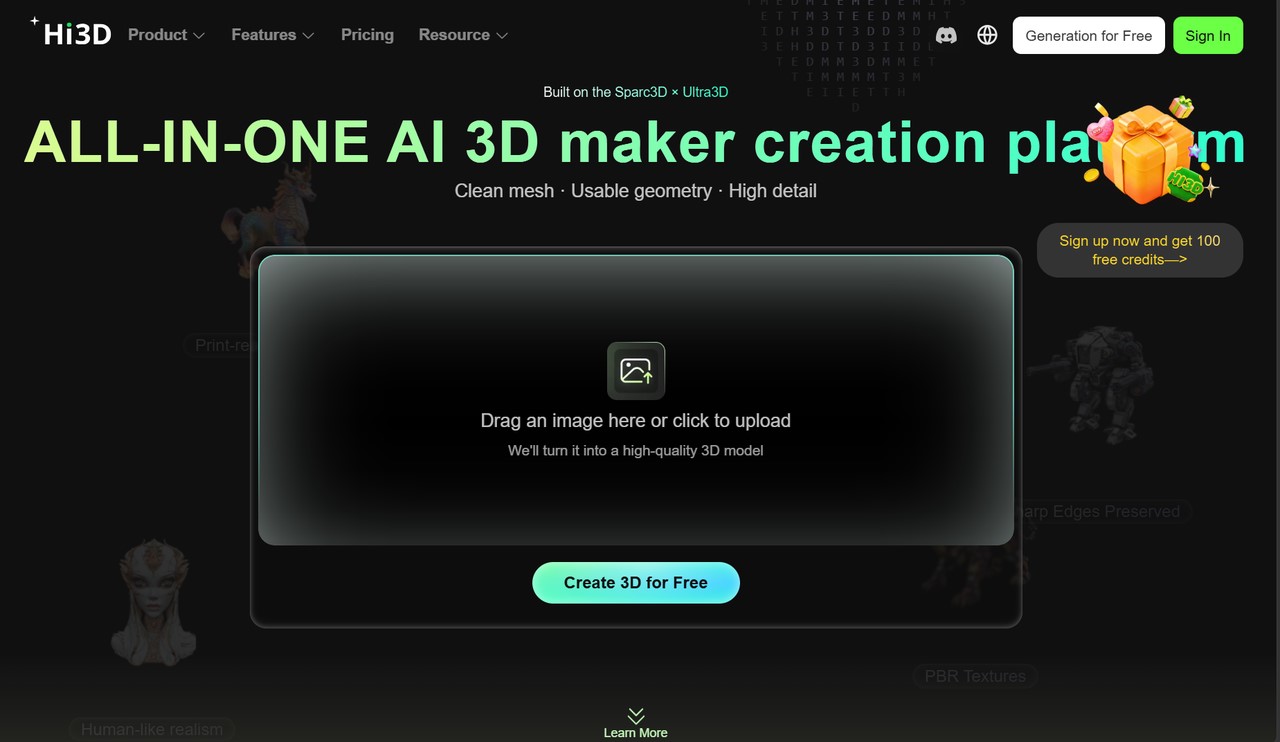
With 2D to 3D image converter, creators can transform two-dimensional images into three-dimensional models. This capability is useful for character designers, product creators, artists, and anyone who wants to explore 3D creation without starting from scratch.
Instead of spending hours rebuilding an object manually, users can use AI-generated results as a foundation and continue developing their creative ideas.
2.2 Creating Models from Text Concepts
Not every project begins with an image. Sometimes creators only have a concept in their mind.
A simple description can represent an idea for a character, product, or creative object. Hi3D allows users to explore these concepts through AI generation, making it easier to experiment with different possibilities.
This approach helps beginners enter the world of 3D creation while giving experienced creators a faster way to test early concepts.
For users looking for a 3D model maker free experience, AI-powered creation reduces technical barriers and provides a simpler way to explore ideas.
3. AI Texture Generation: Adding Realistic Details to AI Models
While geometry defines the structure of a 3D model, textures determine how the object looks and feels.
A model without proper texture may appear incomplete, especially when creating characters, collectibles, product designs, or artistic assets.
Texture creation has traditionally required additional skills, including UV editing, painting, and material adjustment. This makes it another challenge for creators who want professional-looking results.
Hi3D improves this process through AI-based texture generation.
3.1 Faster and Smarter AI Texturing
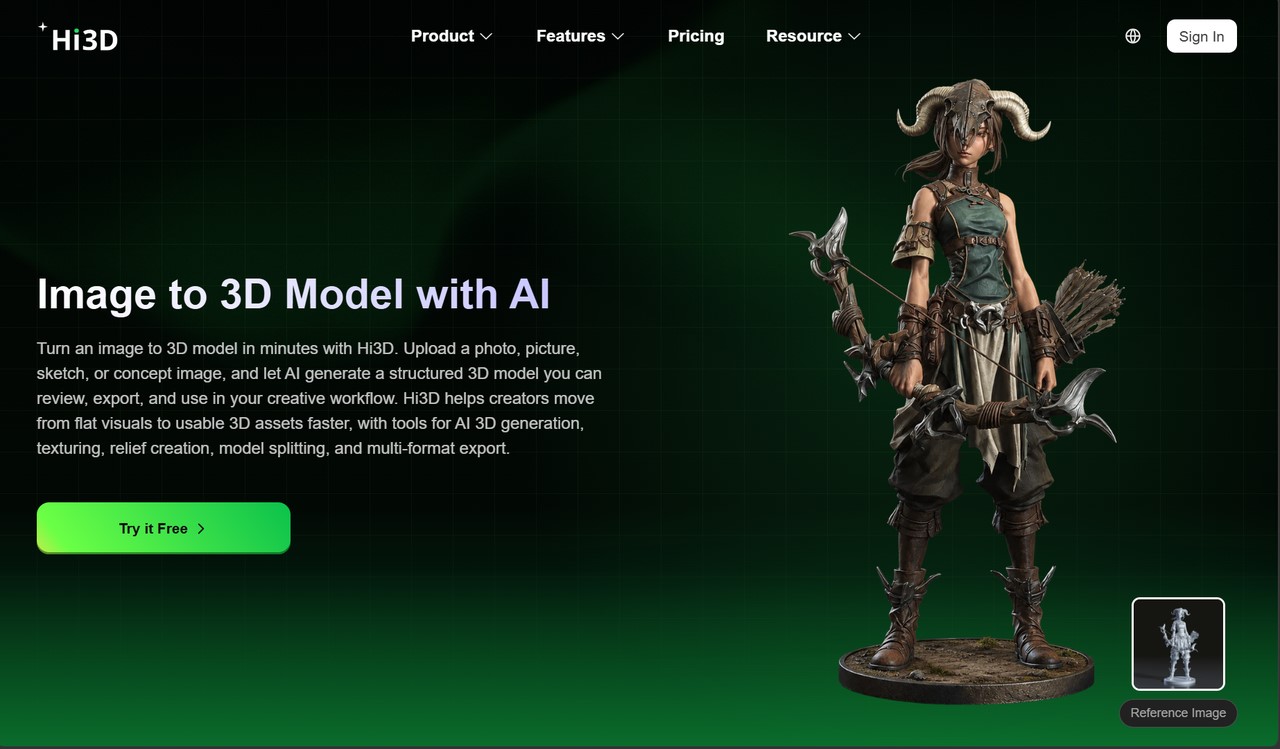
The AI 3D model texture generator feature helps users create detailed textures for AI-generated models, adding colors, patterns, and visual information automatically.
This allows creators to spend less time on repetitive texture work and more time focusing on design decisions.
For example, a character model can receive more detailed surface information, while a product concept can achieve a more realistic appearance before entering production.
3.2 Hi3D V3.0 Brings Higher Texture Quality
Hi3D V3.0 introduces a major improvement in texture generation capability. The latest version increases texture output up to 8K resolution and upgrades the self-developed UV completion algorithm.
These improvements enhance texture edge clarity, color transition continuity, and the recognition of fine patterns when viewed at larger scales.
For creators working on detailed models, this means AI-generated assets can maintain better visual quality and provide stronger support for applications requiring precise surface information.
4. Hi3D V3.0 Official Release: Building More Reliable AI 3D Assets
The release of Hi3D V3.0 represents an important change in AI 3D development.
Instead of focusing only on generating models quickly, the new version focuses on improving the quality and usability of generated assets.
The goal is to reduce the gap between AI creation and real production.
4.1 2048³ Voxel-Level Resolution for More Detailed Models
One of the most important upgrades in Hi3D V3.0 is its improved geometric reconstruction capability.
Hi3D V3.0 increases geometry reconstruction resolution to 2048³ voxel-level and becomes the first commercially available AI 3D model with this level of high precision capability.
Higher reconstruction accuracy allows the system to preserve details that were previously difficult to maintain. Fine structures such as layered surfaces, text edges, logo details, mechanical connections, thin walls, and subtle surface changes can achieve clearer results.
For creators, this improvement means generated models can better maintain their original design intention.
4.2 More Accurate Understanding of Complex Structures
Another challenge in AI 3D generation is understanding areas that are not visible in the original image.
When only one perspective is provided, AI needs to predict hidden surfaces, object relationships, and complex structures.
Hi3D V3.0 improves cross-view structure reasoning, making models more stable from different viewpoints. Side views, back views, and complicated object interactions can achieve better consistency.
This improvement is especially valuable for objects with complex shapes, overlapping parts, or detailed structures.

5. Practical Features That Connect AI Creation with 3D Printing
Creating a model is only the beginning of a complete 3D workflow. To make AI-generated assets more useful, creators also need tools that support preparation and printing.
Hi3D V3.0 continues expanding its practical capabilities.
5.1 Multi-Color Printing for More Creative Physical Models
Color plays an important role in many 3D printing projects, especially character models, collectibles, and personalized objects.
Hi3D’s multi-color printing feature helps transform textured AI models into printable multi-color objects. It improves the relationship between digital textures and real filament materials while reducing unnecessary color fragmentation.
This makes it easier for creators to produce more visually complete physical models.
5.2 Split-for-Printing for Complex Models
Large or detailed models often create difficulties during printing because they may exceed printer size limitations or require complicated assembly.
Hi3D’s split-for-printing feature helps divide models into printable parts and generate connector structures. It supports separating areas such as heads, bodies, arms, legs, and other components while preparing them for assembly.
This reduces the need for complicated manual editing before printing.
5.3 Smart Arrangement for Better Printing Preparation
Before printing, users often need to adjust model orientation, spacing, and slicer settings.
Hi3D provides smart arrangement features that help suggest better print orientations, organize parts on the build plate, and export 3MF files with recommended settings.
These improvements help creators spend less time preparing files and more time creating.
6. From Hi3D V1.0 to V3.0: A Journey Toward Production-Level AI 3D
The development of Hi3D reflects continuous improvement in AI 3D technology.
The first generation focused on improving image-to-3D generation quality by introducing 1536³ voxel-level resolution into a commercial AI model.
Hi3D V2.0 expanded the workflow by combining geometry and texture generation, improving hidden structure completion and creating a more complete creation process.
Hi3D V3.0 continues this evolution by focusing on three major areas: higher geometric precision, stronger structural understanding, and improved texture quality. It also introduces practical workflow functions such as intelligent splitting, multi-color printing, and smart arrangement.
This progression shows that AI 3D technology is moving beyond simple generation and becoming a more complete solution for real creative industries.
6.1 Supporting the Future of 3D Industries with AI
The application of 3D assets is expanding across many fields.
From 3D printing and product design to digital art, gaming, jewelry, collectibles, education, e-commerce, and industrial design, different industries share the same demand for accurate, detailed, and usable 3D models.
Hi3D V3.0 is designed as a general AI 3D solution that helps reduce the difficulty of producing high-quality digital assets.
By improving both generation quality and workflow efficiency, Hi3D helps more creators and businesses explore new possibilities with 3D technology.
6.2 Experience Hi3D V3.0 with Limited 48-Hour Free Access
The official release of Hi3D V3.0 opens a new chapter for AI-powered 3D creation.
To celebrate the launch, Hi3D provides a 48-hour free experience period where users can try Hi3D V3.0 with unlimited generation during the event.
During this period, creators can experience high-precision AI 3D generation, AI texture creation, and practical printing workflow features without restrictions.
After the free experience ends, Hi3D will also provide a 70% discount promotion, allowing more users to continue exploring AI 3D creation.
From a simple image or idea to a detailed 3D model ready for further application, Hi3D V3.0 is making the creative process faster, easier, and more accessible.
The future of 3D creation is not only about generating models. It is about turning ideas into real possibilities.