
UL listed panels and control panels explained
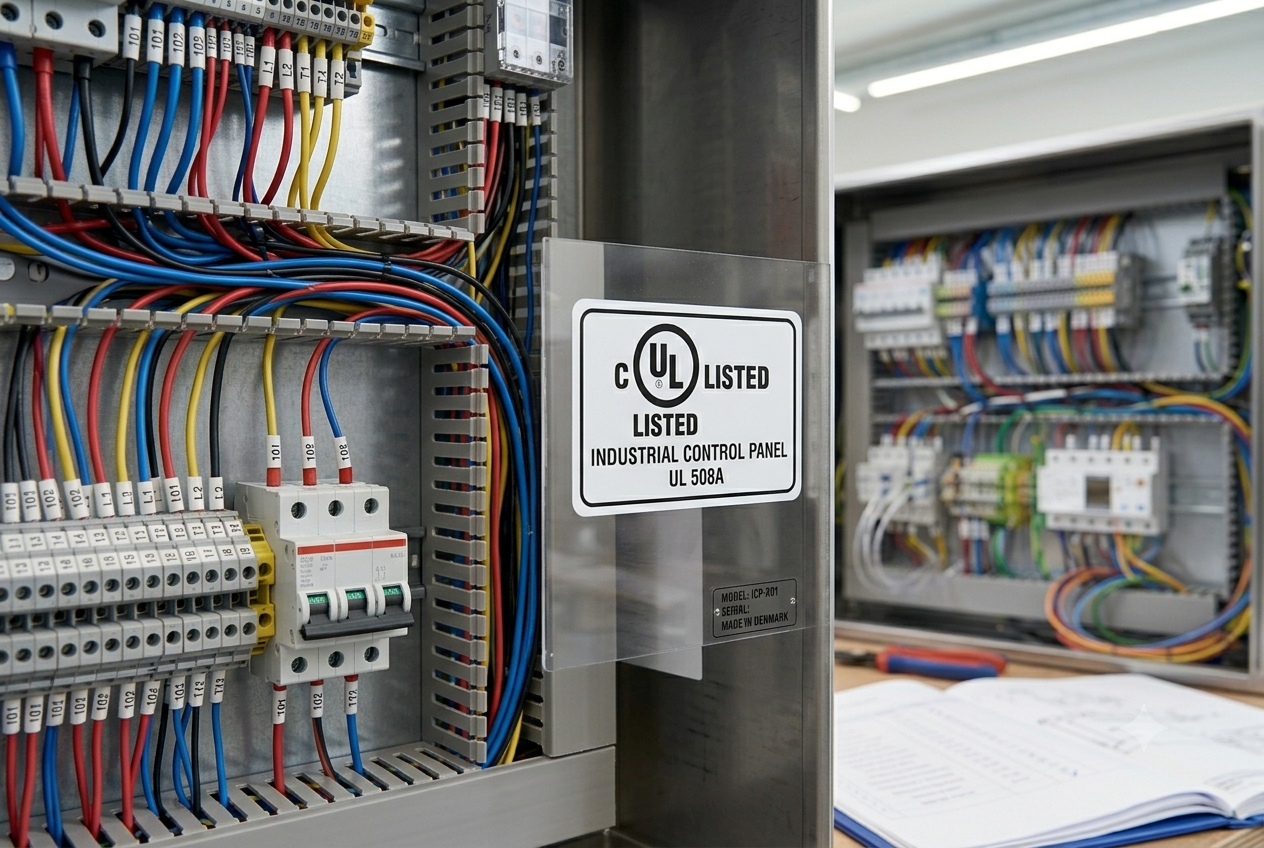
Getting electrical panels into the US or Canadian market is not just an engineering problem. It is a certification problem. UL listing decides whether a panel can legally be installed, and the requirements go well beyond what European CE marking demands. This article explains what UL listing actually covers, how the two main standards differ, and what a compliant build requires from the first design decision onward.
What UL listing actually means
UL stands for Underwriters Laboratories, a North American safety certification body. When a panel carries the UL mark, it tells inspectors and buyers that the build was designed, tested, and documented against a specific safety standard. It is not a quality badge — it is a legal and contractual requirement for selling or installing electrical panels in the USA and Canada.
CE marking is largely a self-declaration of conformity. UL listing involves third-party assessment and ongoing factory inspections by an authorised body. A panel can be perfectly CE compliant and still fail a UL inspection on the other side of the Atlantic. For any export project aimed at North America, sourcing UL-listed panels from a certified manufacturer saves you from a far more expensive problem later.
UL 508A vs UL 891 the practical difference
UL 508A is the standard for industrial control panels, covering wiring practices, component placement and mounting, electrical safety testing, and labelling. If a panel runs a PLC, motor starters, or any kind of machine automation, UL 508A is almost always the standard in play. UL 891 covers low-voltage switchboards and distribution panels up to 600 V — its focus is safe power distribution and protection against electrical faults. You need it when the panel's job is to move power around a site rather than control a process.
Control panels carry more components, more interconnections, and more system-level safety considerations than a distribution board. For customers working with machine controls and automation, UL 508A is usually written into the contract. SystemTeknik holds both certifications across the US and Canadian markets, meaning a single supplier can cover control and distribution under one roof.
How to build a UL-compliant control panel
The process is chronological. Each step depends on getting the previous one right, and shortcuts at the design stage almost always surface during testing.
• Start with the design and the single-line diagram. Component selection, spacing, and the panel layout are decided here, before anything is mounted.
• Specify only UL-recognised or UL-listed components. A component without the right recognition will fail the build regardless of how well it performs.
• Follow the wiring and spacing rules precisely. Wire sizing, routing, and clearance distances are checked against the standard, not against habit.
• Calculate and document the short-circuit current rating (SCCR) for the assembly.
• Run dielectric testing to confirm the panel withstands the required voltage without breakdown.
• Apply the UL label correctly and assemble the documentation package that matches the physical build.
Ordinary industrial control panels can be assembled to good engineering practice without ever touching UL rules, but a UL-certified variant must be built to the standard from the first component choice onward. You cannot certify a finished panel by adding a label at the end.
SystemTeknik's work spans marine, food, pharmaceutical, energy, data centres, and OEM manufacturing — each sector adds its own constraints on top of UL requirements. Knowing how the standard interacts with real production environments is what keeps panels from being reworked after inspection.
Mistakes that cause UL certification failures
Most failed inspections come down to a handful of recurring errors — rarely exotic, usually small things overlooked at the build stage.
• Using components that are not UL-recognised or UL-listed for the application.
• Incorrect wire sizing or routing that breaks the spacing and clearance rules.
• Missing, wrong, or poorly applied labelling on the panel.
• Documentation that does not match the physical build.
• An SCCR that is undefined or wrongly calculated for the assembly.
None of these is hard to avoid, but each one can stop a finished panel from passing. Fixing them after assembly costs far more than catching them on the drawing board.
Documentation and labelling requirements
A UL-listed panel is only as compliant as its paperwork. The physical build and the documentation have to tell exactly the same story.
The required package includes wiring diagrams, a component schedule listing every part and its rating, the short-circuit current rating, and the physical UL mark on the panel itself. An inspector will cross-check documents against the hardware — if the schedule lists one breaker and the panel contains another, that mismatch alone can fail the inspection.
This is one of the most common areas where panels fall short during third-party assessment: the build can be technically sound and still get rejected because the records do not line up. SystemTeknik's dual-certification scope across both North American markets, combined with ISO 9001 and ISO 14001 accreditation and a service team working on panels 30 years old and older, is a useful reference for what full compliance looks like in practice.
Getting it right from the start
UL certification decides whether a panel can legally be installed in North America and whether it will survive site inspection. Get the design, the components, and the documentation right from the beginning — it is always cheaper than reworking a finished build.