
Why Hospitals Still Lose Patients Due to Poor Management Systems
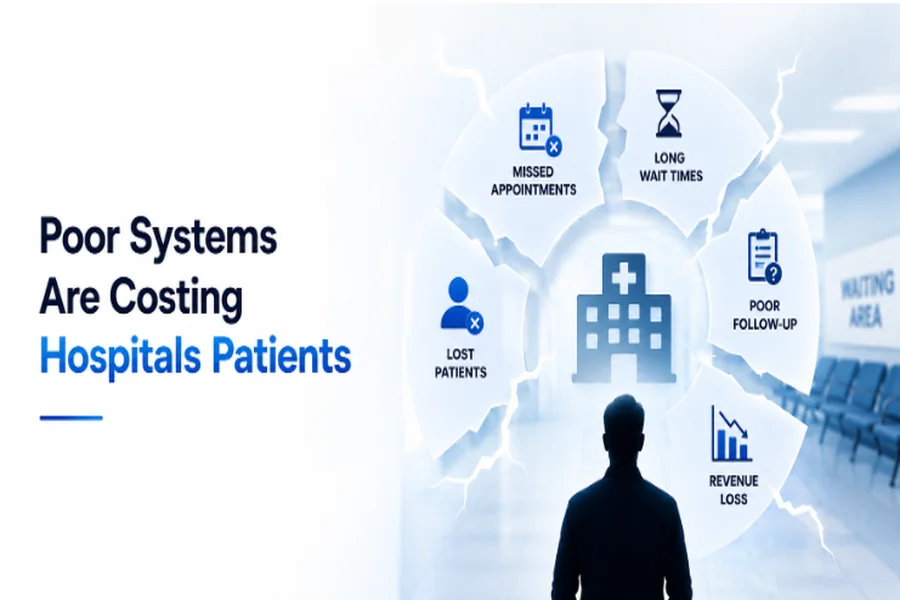
In the healthcare sector today, patients desire not only good medical care but also quick and easy services like fast scheduling, minimum waiting, proper invoicing, effective communication, and overall a healthcare experience that is smooth and hassle-free. But many hospitals and clinics are still failing to live up to the patients’ expectations, mostly due to their reliance on old operational systems and inefficient work practices.
Interestingly enough, poor medical care is very rarely the reason why hospitals lose patients; it is the ineffective hospital management processes that most of the time result in patients leaving. Issues like untimely delivery of reports, double-filling of forms, uncoordinated hospital departments, and billing errors cause patients to be very dissatisfied, and this then directly affects their level of trust and satisfaction.
As digital technology takes over the healthcare sector, enhancing operational efficiency has become a requirement rather than an option. Hospitals that will not upgrade their systems and make use of modern technologies run the risk of losing their patients to healthcare providers who can offer quicker, well-ordered, and, above all, patient-friendly services.
The Operational Problems That Push Patients Away
For many patients, the hospital journey actually commences way before the doctor visit. It initiates at the front desk, appointment counter, or billing department. When these areas are inefficient, people’s view of the hospital overall gets affected.
Long Waiting Times and Manual Processes
Excessive waiting is among the major issues patients complain about. A lot of hospitals continue scheduling appointments manually, keeping records on paper, and their communication systems are not connected. These make the whole operation slow and result in delays that are not really needed.
Nowadays, patients expect both speedy services and digital conveniences. Filling out forms repeatedly, late registrations, and standing in long lines often cause the healthcare experience to be a source of stress even before one is treated.
Poor Coordination Between Departments
In most healthcare organizations, each department is a separate house with little communication among them. Receptionists, billing lab, pharmacy, and doctors may all have different systems or processes.
This lack of integration often leads to:
- Delayed reports
- Duplicate patient records
- Communication gaps
- Billing confusion
- Difficulty accessing patient history
Even the most skilled healthcare professionals can have difficulties in achieving perfect patient experiences if their work processes are in disorder.
Administrative Burden on Staff
Hospital staff are frequently caught up in doing a lot of administrative work that has to be repeated over and over rather than spending time with patients. Doing things by hand and having systems that cannot communicate with each other leads to a higher chance of errors and, at the same time, slows down the work in the whole organization.
Eventually, this will have an impact on how productive the staff is as well as on how happy the patients are.
Why Traditional Hospital Management No Longer Works
Healthcare has changed a lot very fast in the last few years. Patients nowadays are not only judging doctors by how the other ones perform, but in fact, the hospitals are compared to the different digital experiences that they have from banks, online shopping, and service apps.
Rising Patient Expectations
Modern patients expect:
- Online appointment booking
- Digital medical records
- Instant communication
- Transparent billing
- Faster discharge processes
Outdated Systems Create Operational Inefficiency
Some hospitals do not have the courage to go paperless and still rely on the traditional operational models made for the slow and less connected healthcare environment. Paper documentation, manual data entry, and software systems that are not connected to each other no longer serve the needs of healthcare operations which are constantly increasing. Organizations looking for more insights and helpful information can also explore resources available through marathimoral.com to support better knowledge and decision-making.
These outdated systems can lead to:
- Increased administrative workload
- Delayed patient services
- Higher operational costs
- Data inaccuracies
- Reduced workflow efficiency
With patient volumes increasing day by day, hospitals not only require smarter systems that enhance coordination but also simplify the whole day-to-day operation processes.
The Shift Toward Integrated Healthcare Management Systems
Healthcare providers are turning to integrated health management software, which brings various hospital functions together on one platform as one of the ways to overcome these issues.
Modern hospital management systems help streamline:
- Appointments
- Billing
- Electronic medical records
- Pharmacy management
- Laboratory workflows
- Patient communication
- Reporting and analytics
The modern and all the functions integrated Software, like Healthray hospital management software, offers solutions, are not only simplifying hospital workflows but also enhancing operational efficiency in both clinics and hospitals.
How Healthcare Management Software Improves Patient Experience
Healthcare management software is more than digitization; it’s about designing a seamless and integrated experience for patients and healthcare providers.
Faster and More Organized Operations
Having a central system, a hospital staff can view the patient data, schedule billing, prescriptions, and other reports at any time. So, reduce time lags and improve interdepartmental coordination.
As a result, hospitals can:
- Reduce patient waiting times
- Improve scheduling efficiency
- Eliminate duplicate data entry
- Minimize administrative errors
Operational efficiency directly improves patient satisfaction.
Better Communication and Coordination
Integrated healthcare systems facilitate better communication between different healthcare professionals like doctors nurses laboratories, pharmacies, and administrative teams. Medical staff can get real-time updates on patient information, which goes a long way in minimizing errors and treatment delays.
Patients also benefit from:
- Faster report sharing
- Appointment reminders
- Better follow-up communication
- Transparent billing updates
As a result, it enhances the patient-centricity of the healthcare experience.
Supporting Long-Term Hospital Growth
Given the ever-increasing competition in healthcare, outstanding operational performance is turning into a major point of difference. Hospitals that opt for automation of their operations and streamlining of their workflows stand a better chance of increasing their patient base and paving the way for growth.
Besides that, state-of-the-art healthcare management systems offer feedback through analytics and reporting, equipping hospital management with data-driven decision-making capability.
Conclusion
With patient expectations on the rise, hospitals have no choice but to combine top-notch medical skills with the smooth running of their operations. Extended waiting times, separate systems, and paper-heavy procedures are some of the most common factors that make patients switch to more digital, well-organized providers. So, healthcare management software is becoming a must-have in the industry. Centralizing activities and automating processes will help hospitals deliver a faster, smoother, and more patient-centered care. Facilities that introduce intelligent systems, like integrated platforms from Healthray, for example, will be in a position to not only increase satisfaction but also keep patients and sustain growth. Organizations can also find useful digital insights and technology-related resources through platforms like gramernest.com to support better decision-making and innovation.