
Why UL panels matter for export
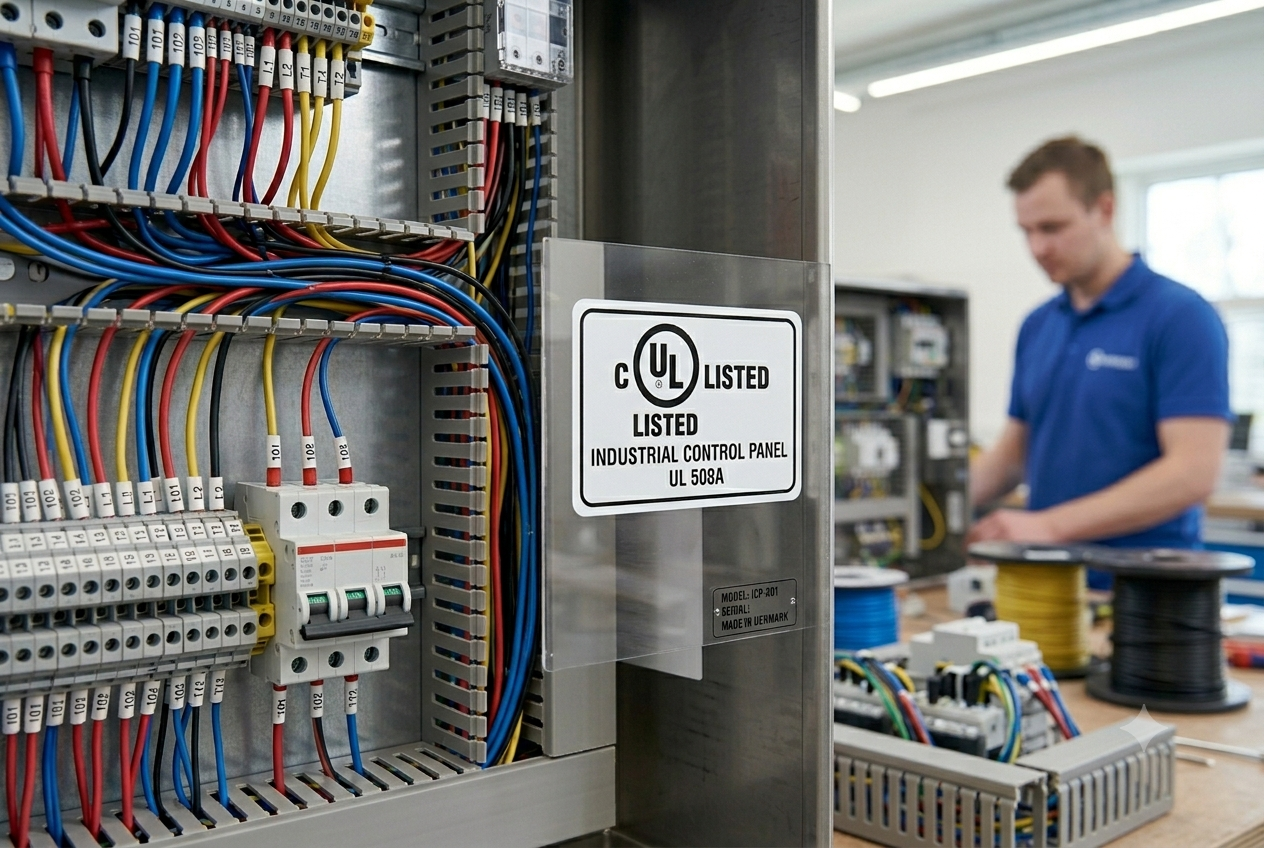
Getting a piece of equipment into the US or Canadian market is straightforward until it isn't. For most manufacturers, the panel is where things stall. North America does not accept CE marking as a substitute for UL certification, and a panel that was not built to the right standard from the start cannot simply be relabelled at the border. This article covers what UL certification requires, why it affects export timelines, and what the most common compliance mistakes look like before they become expensive.
What UL certification actually requires
UL certification is not an abstract badge. It is a set of practical demands placed on how a panel is designed, built, documented, and labelled before it can legally be sold or installed in North America.
The two standards cover different equipment. UL 508A applies to industrial control panels used in machine control and automation. UL 891 covers switchboards and low-voltage distribution panels up to 600V. Both check the same categories: wiring and clearance distances, component placement, electrical safety testing, and correct labelling.
A compliant panel arrives with complete electrical documentation and the correct labels attached, because an inspector at the point of entry will look for both — miss either and the panel can be held. A panel meant for the US or Canada must be built and documented to these standards from the outset, which is exactly the work a certified builder of UL-certified panels handles as part of the process.
The export barrier most manufacturers encounter too late
Here is the pattern that catches companies out. A manufacturer designs a strong piece of equipment, lands a customer in the US or Canada, and only then learns that the control panel inside it needs UL certification. By that point the design is finished.
Retroactively certifying a non-compliant panel is expensive. It often means redrawing the panel layout, swapping out components that lack UL recognition, rerouting wiring to meet clearance rules, and rebuilding the documentation package from scratch. A failed inspection at the border can stall a shipment for weeks, and a customer waiting on equipment does not stay patient forever.
The practical fix is to bring a certified panel builder into the project at the design stage, so the panel is built right the first time and documentation grows alongside it.
Common mistakes that push compliance to the last minute include:
• Assuming a CE-marked panel is automatically accepted in North America, which it is not
• Selecting components without checking for UL recognition or listing
• Finalising the panel layout before involving anyone familiar with UL clearance rules
• Treating documentation as paperwork to produce afterwards rather than during the build
• Discovering the requirement only when a North American customer raises it
The earlier compliance enters the conversation, the cheaper and faster the project runs.
Where UL 508A and UL 891 differ
The two standards are not interchangeable. UL 508A governs industrial control panels — machine control and automation logic — and is the more commonly required certification, often written directly into North American supply contracts. UL 891 applies to switchboards and low-voltage distribution panels up to 600V, where the job is distributing power across a facility rather than controlling a process.
One does not substitute for the other: a panel that both distributes power and controls machinery may touch both worlds, but UL 891 does not cover the control functionality that UL 508A demands.
Why Denmark has only one certified builder
UL certification is hard to get and harder to keep. It calls for investment in documented processes, traceable component records, and ongoing audits by UL itself — which is why so few panel builders outside North America hold it.
Systemteknik carries dual UL certification covering both UL 508A and UL 891, alongside ISO 9001, ISO 14001, and an AAA credit rating. You can read more about the company's background at Systemteknik. Holding both UL standards means the same builder can handle a control panel and a distribution board under one roof, with one documentation discipline behind both.
What the full-process model looks like in practice
For an export project, the most useful thing a builder can offer is a single point of responsibility. A complete UL panel build runs through a clear sequence: design to specification, physical build using recognised components, documentation, correct labelling, and compliance verification before the panel ships. The same certified process serves both the US and Canadian markets.
• A panel designed and built to the applicable UL standard
• Correct UL labelling applied and ready for inspection
• Complete electrical documentation accompanying the panel
• Compliance verification before dispatch
• One contact responsible for the whole chain
For a company managing an export deadline, that clarity is worth as much as the certification itself.
A final thought on market access
Panel compliance for North America is fixed. You either meet the UL standard or your equipment waits at the border. Build it into the project from the first drawing — a certified builder with full-process capability takes the guesswork out of getting in.