
Give Kimg Editorial Illustrations a Disagreement to Explain
Three essays about communication can arrive with almost the same picture: an envelope, a phone, and a speech bubble floating in an agreeable blue space. One essay argues that people need fewer messages. Another argues that silence excludes newcomers. The third asks why important notices go unread. Their illustrations could be exchanged without anyone noticing.
That interchangeability is a useful warning. A subject tells you what objects might appear in a picture. An argument tells you what those objects should be doing to each other. For an essay illustration, begin with the disagreement the reader will encounter. You can then explore a visual relation that adds something to the headline, instead of commissioning another attractive picture of the topic.
Find the Claim That Another Editor Could Dispute
Take a hypothetical essay about a neighborhood newsletter. Its author thinks shorter notices will improve participation. That is a claim with an opposing view: perhaps the notices are already short but omit the information a new resident needs. The disagreement concerns what has been removed and who must fill in the gaps. An envelope alone cannot express it, however carefully it is rendered.
Reduce the brief to one sentence before considering style. For this essay, the sentence might be: cutting a notice can make it easier to scan while making it harder to act on. Do not ask the picture to cover every supporting example. Select the tension with the greatest consequence for the intended reader. If two editors cannot agree on that sentence, generating pictures will multiply an unresolved editorial decision.
Kimg AI offers a way to explore images from written descriptions. Its usefulness in this task depends on the description you supply. A prompt containing only newsletters, community, and modern communication is likely to invite a broad topic illustration. The more productive brief describes a relation, such as a folded sheet with its crucial connecting piece placed just beyond reach.
Make the Objects Express the Missing Relationship
The first visual decision is about action. A sheet can be shortened, split, obstructed, or passed across a gap. Those actions imply different arguments. A shortened sheet suggests editing. A blocked sheet suggests access. A scattered pile suggests overload. Choose deliberately, because a viewer will read these relations before noticing the texture or color palette.
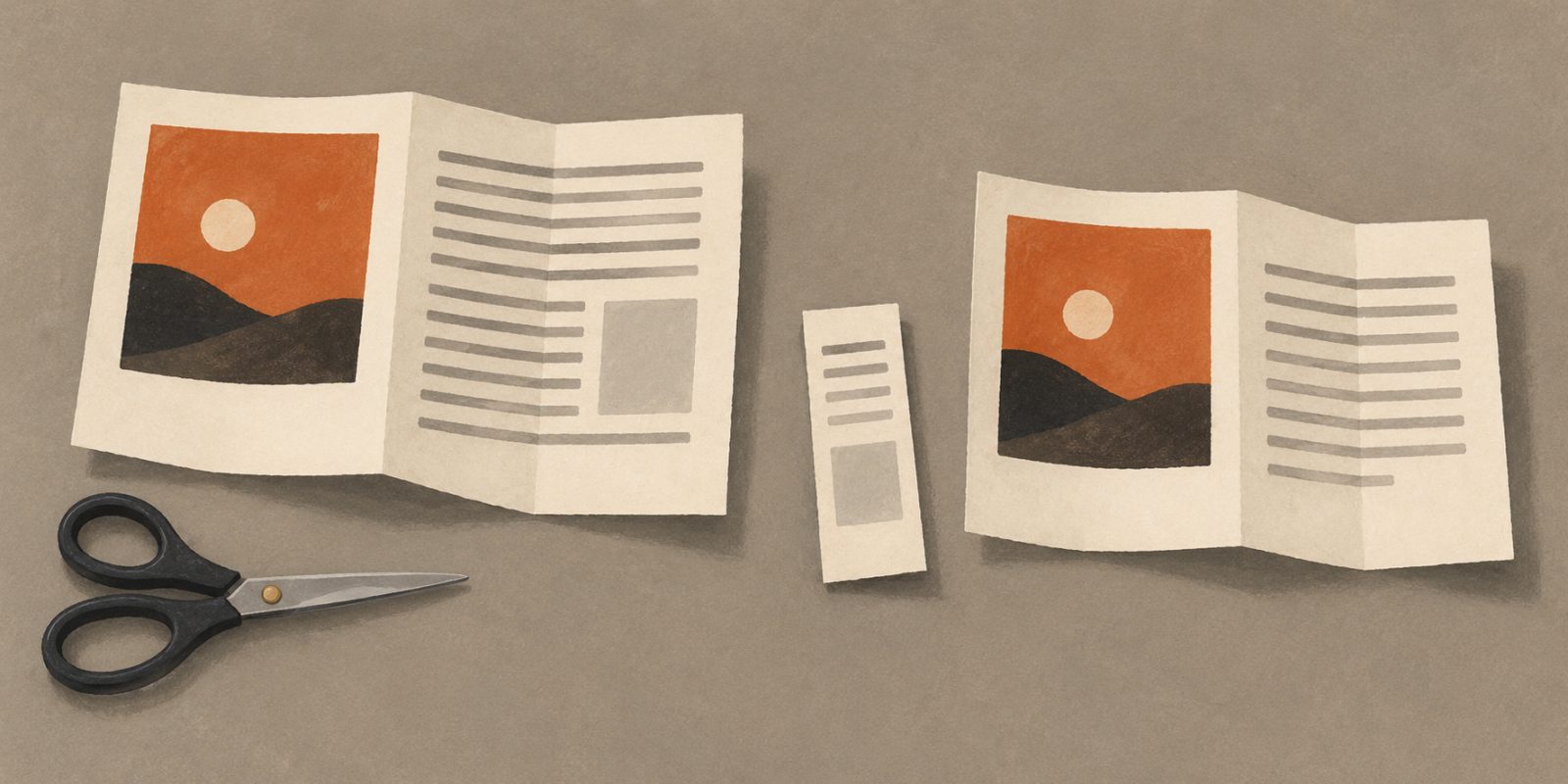
Using Kimg for an initial concept, describe two folded paper forms separated by a narrow gap, with one small missing piece visible between them. Keep the setting spare enough that the gap carries the meaning. This is an illustration of an editorial question, not a reconstruction of a real newsletter or an image of a particular resident’s experience.
You can also reject a metaphor early. A locked mailbox might suggest censorship, even though the essay concerns accidental omission. An overflowing inbox shifts attention toward volume. Both are understandable pictures, but neither is a neutral substitute for a missing piece. Put rejected concepts beside the brief and write the reason for rejecting them. That gives the eventual choice a basis beyond personal taste, and it prevents a striking but misleading image from returning simply because someone prefers its colors.
Once that relation is legible, consider how style changes its tone. Torn paper can make a routine editing choice seem hostile. Softly folded paper may suggest an unintended omission. A dramatic spotlight could exaggerate an ordinary inconvenience into a crisis. Ask whether the emotional temperature belongs to the essay. Visual specificity helps only when it is specific to the argument you actually intend to publish.
Kimg AI supports transformations from an uploaded image, including changes in artistic style. If you have a concept with a useful arrangement, a style variation can help explore its tone. It should remain a candidate rather than a promise of exact preservation. Compare the relation again after the transformation; a prettier version may close the gap or hide the missing piece that made the concept relevant.
Ask a Reader to Explain the Opposite Interpretation
Before showing someone the full essay, ask what the image seems to be saying. Then offer the opposing claim and ask whether the same picture supports it equally well. Use the answer to identify ambiguity while the composition is still easy to change.
In the newsletter example, the missing piece could suggest that readers should work harder to complete the message. That would place responsibility on the audience rather than on the editor. The ambiguity might be useful if the essay examines both sides. If the essay firmly criticizes missing practical detail, however, the picture needs a clearer sign that the omission occurred before the notice reached its reader.
A variation from Kimg AI could place the removed piece next to a pair of scissors while keeping the receiving side empty. The change gives the omission a visible origin. It also introduces a stronger suggestion of deliberate cutting, so you must decide whether that implication is fair. More literal detail does not automatically make the illustration more accurate to the essay.
Sometimes both readings remain plausible because the argument itself is balanced. Keep that tension if it is intentional. An illustration does not need to settle a debate the article leaves open. It should make the relevant choice visible. What it should not do is announce a certainty that the author carefully avoids, simply because a decisive picture feels more compelling at thumbnail size.
Try one further comparison with the headline covered. If the image becomes meaningless without the exact title, the visual relation may be too private. If it becomes a generic statement about all communication, it may be too broad. The useful middle ground is a recognizable action with enough room for the accompanying essay to explain its consequences.
Keep feedback descriptive. “The missing piece looks like the reader’s fault” gives you a decision to make. “It needs more impact” does not. Ask the reviewer to point to the object or spatial relation that produced the reading. That keeps a discussion about editorial meaning from turning into an unfocused vote on favorite colors.
Send a Visual Brief With One Editorial Job
When you have a promising concept, preserve the sentence that motivated it and the interpretation you want to avoid. Those two notes help an illustrator or editor make later changes without losing the argument. Keep them in the working brief. The published caption can identify the image as an illustration without carrying the entire internal discussion.
Kimg AI can help a small editorial team explore this early stage, especially when a written brief is still too abstract to discuss. It does not replace an editor’s responsibility for what the finished image implies. Commission original illustration when a distinctive visual voice or a complex treatment is central to the piece.
The accepted image should have a job you can name: reveal an omission, expose an imbalance, or hold two plausible readings in view. If it only repeats the headline’s nouns, return to the disagreement before adding another decorative detail.