
Portable Power Station vs. Inverter: What’s the Difference?
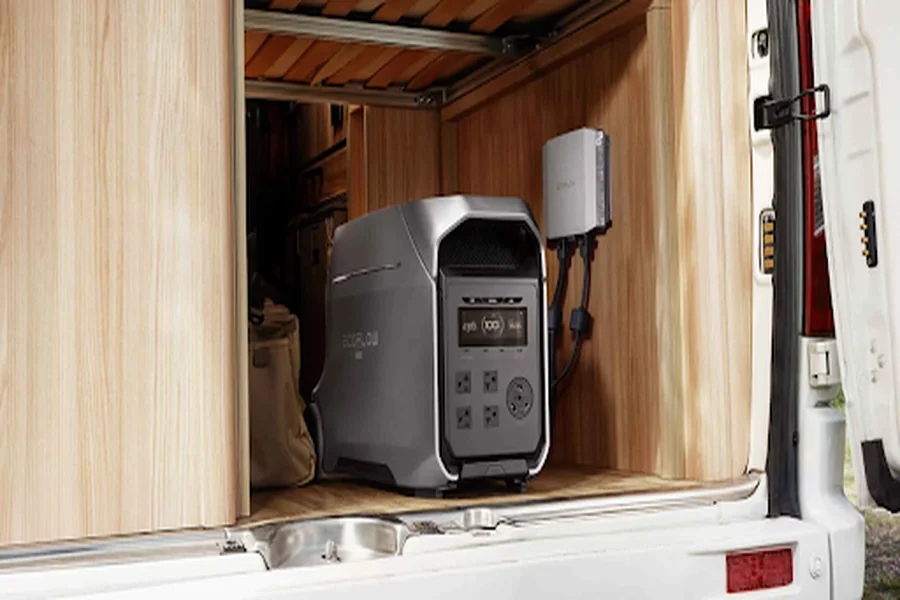
A portable power station combines a rechargeable battery, charging electronics, and power outputs in one unit. Models with AC outlets also contain an inverter. A standalone inverter performs one main job: converting DC electricity from an external source, usually a battery, into AC electricity for appliances.
The practical choice is therefore between buying a complete portable system and adding a component to a separate battery system.
Here, “inverter” means a battery-powered electrical device. An inverter generator is a different product that uses an engine and fuel to generate electricity.
What Does Each Option Include?
With an AC-equipped power station, the manufacturer has already matched the battery, inverter, charging system, and internal protection components. You charge the unit and connect equipment to its supported outlets.
A standalone inverter needs a suitable external DC supply. For battery-powered operation, that means a battery with the correct voltage and sufficient discharge capability, along with appropriate connections and protection.
| Component or function | AC-equipped portable power station | Standalone battery inverter |
| Energy storage | Battery included | External battery required |
| DC-to-AC conversion | Built-in inverter | Main function of the device |
| Battery charging | Supported charging inputs included | Requires separate charging equipment unless it is an inverter/charger |
| Battery connections | Internal connections already assembled | External cables and protection must suit the installation |
| USB and DC outputs | Commonly included | Availability depends on the model |
This also answers a common buying question: you do not need a second inverter to use the AC outlets on a portable power station.
Some compact power stations provide only USB and DC outputs. Those models cannot run an ordinary AC appliance directly, so check the available outputs rather than relying on the product category name.
Why Equal Watt Ratings Do Not Mean Equal Capability
A 2,000W inverter and a power station rated for 2,000W continuous AC output may support similar running loads. That number says nothing about how long either setup can supply them.
Two separate specifications matter:
- Watts (W) describe power: how much equipment the system can operate at a given moment.
- Watt-hours (Wh) describe stored energy: a major factor in how long that equipment can run.
For illustration, a fully charged 1,000Wh battery supplying a constant 100W load would provide ten hours in a calculation that ignores losses and operating limits. Actual AC runtime is shorter because conversion consumes energy, the system itself uses power, and not all nominal battery capacity may be available.
A standalone inverter has no comparable runtime figure by itself. Connect it to a different battery bank and the available runtime changes, even though the inverter’s wattage stays the same.
The external battery must also deliver enough current. Pairing a powerful inverter with a battery that cannot support its demand does not create a high-output system. Battery protection may shut the system down before the inverter reaches its advertised rating.
Appliance compatibility requires another distinction: continuous output and starting surge are different ratings. Motors and compressors can briefly demand more power when starting. Both types of system need sufficient surge capability for the required duration.
Finally, compare the AC waveform. Pure sine wave output generally offers broader appliance compatibility than modified sine wave output. It is available in both product categories; buying a separate inverter does not automatically mean accepting lower-quality AC power.
An Inverter Does Not Automatically Charge the Battery
An ordinary standalone inverter takes energy from a battery to supply AC loads. Replenishing that battery requires a charging system.
For example, charging from a wall outlet requires a charger suited to the battery’s voltage and chemistry. Solar charging requires suitable charge-control equipment. These functions may be separate components or combined in a more capable device.
An inverter/charger combines DC-to-AC conversion with battery charging from an AC source. It still uses an external battery. Some combined units also provide automatic transfer between an external AC supply and battery power, but that functionality should be confirmed for the particular device.
Portable power stations package charging functions into the product, although supported sources and charging rates vary. Wall charging, vehicle charging, and solar charging can have substantially different input limits on the same unit.
Consequently, a high AC output rating does not prove that a system recharges quickly. Compare the charging input you will actually use, especially when the time available between uses is limited.
How the Choice Affects Installation and Future Changes
For equipment plugged directly into its outlets, a portable power station removes much of the assembly work. There is no separate battery bank to mount or inverter-to-battery cable to size. The battery and outlets also move together when you relocate the unit.
A separate inverter system gives you more control over its layout. The battery can occupy one suitable location while the inverter sits elsewhere within its installation requirements. That flexibility is useful in a permanent setup, but cable length, voltage drop, ventilation, and circuit protection become part of the design.
Separate components can also make later changes more targeted. You may be able to replace the inverter while keeping a suitable battery bank, or change the charging equipment without replacing everything. Compatibility still needs to be reassessed; a higher-output inverter may require changes to the battery connections and protection.
Some portable power stations support additional batteries, but expansion follows the manufacturer’s supported combinations. Adding battery capacity usually increases runtime without increasing the unit’s AC output limit.
When comparing purchase costs, include the complete working system: battery, inverter, charging equipment, cables, protection, and any installation work. Comparing an inverter alone with a complete power station leaves out essential components.
Conclusion
If you are starting without a battery system and want movable power for plug-in equipment, an AC-equipped portable power station is the more straightforward choice. If you already have a suitable battery bank—or are designing a permanent installation—a standalone inverter lets you add the AC capability that system needs. Start with what is already available and what must be added; the largest wattage on the box cannot make that decision for you.