
Slatted Wall Panels for Education: Managing Noise in Lecture Theatres, Corridors and Learning Commons
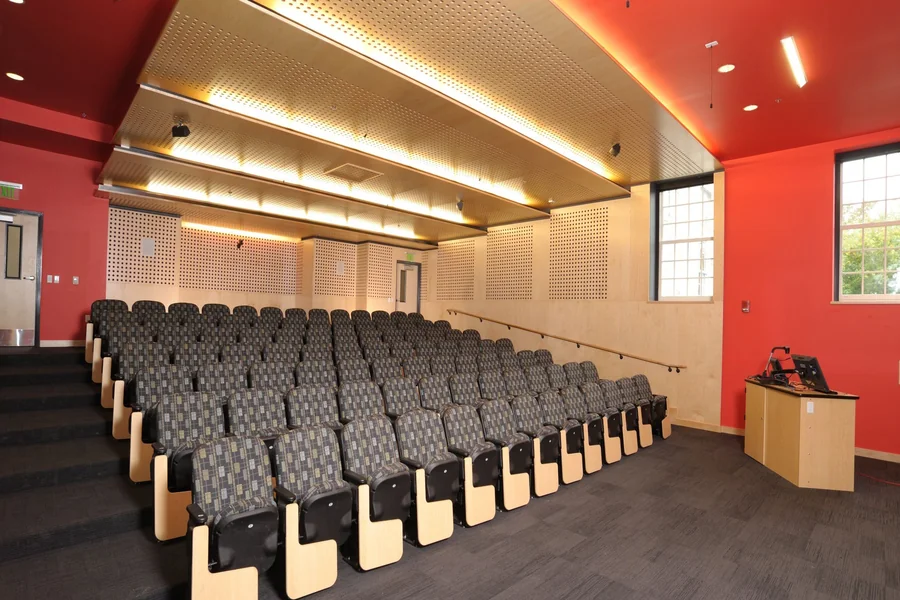
Anyone who’s spent time in a busy secondary school corridor or a packed university library at exam time knows education buildings can get genuinely loud. Hard floors, high ceilings and constant movement all add up, and that noise has a real effect on how well people can concentrate, teach and learn. Research into classroom acoustics has repeatedly found that excessive background noise makes it measurably harder for students to follow instruction, particularly for younger pupils and those learning in a second language.
Lecture theatres need clarity above almost anything else
In a large lecture theatre, the single most important acoustic job is speech intelligibility, making sure a lecturer at the front can be clearly heard by someone sitting right at the back without needing a booming microphone system to compensate for a poorly treated room. Slatted wall panels with acoustic backing help control reverberation across these bigger volumes, which genuinely improves how clearly speech carries, and it makes a noticeable difference to how tired both students and lecturers feel after a long day of back to back sessions.
Corridors and shared spaces have a different problem
Corridors aren’t really about speech clarity, they’re about managing general noise buildup from constant footfall and chatter between classes. A slatted panel treatment along a busy corridor wall can take the edge off that noise without needing to redesign the space, and it has the added bonus of giving what’s often a fairly plain, functional area some genuine visual interest, which matters in buildings where corridors make up a surprisingly large proportion of the total floor area.
Learning commons need flexibility
Modern learning commons, the shared, flexible study and collaboration spaces that have replaced a lot of traditional libraries, present their own challenge, since they need to support both quiet, focused study and more social, collaborative activity within the same open space. Acoustic slatted wall systems can help create a bit of separation and calm within an otherwise open plan area, without needing full height partition walls that would kill the flexibility the space is designed for in the first place.
Designing for the whole building, not just one room
The best approach for an education project usually involves thinking about acoustic treatment across the whole building rather than tackling each room in isolation. A lecture theatre with brilliant acoustics surrounded by echoey corridors and a noisy learning common doesn’t actually deliver the calm, focused environment a school or university is aiming for. Treating slatted wall panels as part of a wider building strategy, rather than a one-off design flourish, tends to get much better results for everyone using the space day to day, from first year students right through to the staff who spend their entire working life within the same walls.
Budgets and priorities in education projects
Education budgets are often tighter than in other commercial sectors, which means acoustic treatment sometimes gets prioritised unevenly across a building, usually concentrated in the flagship spaces a school or university wants to show off to prospective students and their families. It’s worth pushing back gently on that instinct where possible, since the corridors and shared spaces that don’t feature in the prospectus photos are exactly where students and staff spend a huge amount of their actual time. A modest amount of acoustic treatment spread sensibly across the whole building often delivers more genuine benefit than concentrating the entire budget on a single showpiece lecture theatre, and it tends to be appreciated by far more people over the course of an ordinary working week.