
Glassless Shatterproof Mirror: Is It Better Than Glass?
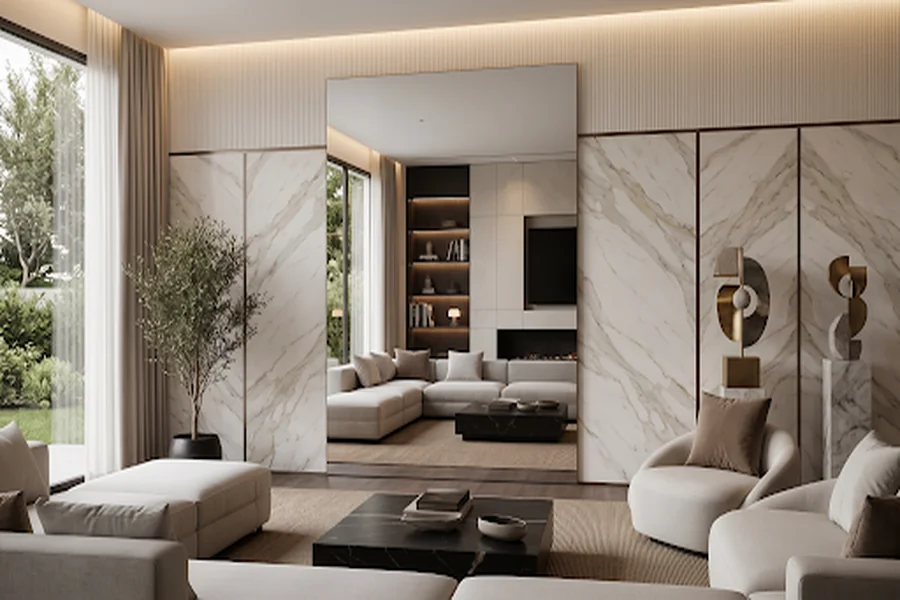
Mirrors are usually associated with one material: glass. But that assumption is changing as homeowners, gym owners, schools, designers, and commercial facilities look for reflective surfaces that are lighter and less vulnerable to breakage. The term glassless shatterproof mirror generally describes a mirror system that creates a reflective image without relying on conventional glass as the front reflective surface. Depending on the product, the construction may use reflective film, polymer materials, or another engineered surface attached to a rigid backing.
That distinction matters because “glassless,” “acrylic,” and “shatter-resistant” are not interchangeable terms. They describe different construction approaches, and each has its own advantages and limitations.
What Is a Glassless Mirror?
A glassless mirror is designed to provide a mirror-like reflection without a traditional glass mirror panel. Some systems use optical-grade reflective film mounted to a rigid substrate, while others use mirrored plastic such as acrylic.
The objective is usually the same: reduce the risks and handling difficulties associated with conventional glass. Traditional mirrors typically consist of a glass substrate with a reflective coating on the rear surface. Glass provides excellent rigidity and a stable reflective plane, but it is also comparatively heavy and can break when subjected to sufficient impact.
Glassless construction approaches replace some or all of those characteristics with lighter, impact-resistant materials. This is particularly relevant in environments where mirrors are frequently transported, repositioned, installed over large areas, or exposed to accidental impacts.
Glassless vs. Glass: What Is the Real Difference?
The biggest difference is not simply whether one mirror contains glass. It is how the reflective surface behaves under real-world conditions.
A conventional glass mirror is rigid and provides a stable surface for reflection. That rigidity contributes to the crisp appearance people generally expect from a high-quality wall mirror.
A glass-free mirror system can be considerably lighter and more resistant to impact. Some professional systems use a rigid backing behind reflective film to help maintain a flat reflective surface. This construction can make the mirror easier to handle while reducing the consequences of an accidental impact.
However, eliminating glass does not automatically make a mirror superior. The important questions are:
- How accurately does it reflect?
- How flat does it remain after installation?
- How easily does the surface scratch?
- What happens when it is impacted?
- How does it perform at large dimensions?
- How should it be cleaned?
- Is the construction appropriate for the intended environment?
Why Weight Matters for Large Mirrors
Weight becomes a significant consideration as mirror dimensions increase. Acrylic mirror, for example, is substantially lighter than comparable glass because acrylic has a much lower density. Industry comparisons commonly place acrylic mirror at around half the weight of similarly sized glass, although the actual finished weight depends on thickness and construction.
Glassless film-based systems can reduce weight even further depending on their backing materials. One U.S. manufacturer, for example, describes its glass-free mirror systems as approximately 90% lighter than glass.
Lower weight can simplify more than transportation. It can affect wall loading, installation labor, handling during remodeling, temporary installations, portable studio equipment, and large mirror assemblies.
For a small bathroom mirror, the difference may be irrelevant. For a wall consisting of several large mirror panels, it can become a major installation consideration.
Are Glassless Mirrors Actually Shatterproof?
This is where terminology needs to be handled carefully. “Shatterproof” is widely used in the mirror industry, but consumers should not assume that every non-glass mirror is literally impossible to damage.
Acrylic mirror is impact-resistant and does not fracture into the same sharp glass shards produced by conventional glass. It can nevertheless crack, chip, dent, or otherwise become damaged under sufficient force.
Film-based systems have a different failure behavior again. Instead of a large glass sheet breaking, the reflective layer and backing may deform or sustain localized damage. Therefore, the more useful concept is breakage behavior, not an absolute claim that a mirror cannot break.
For schools, children’s spaces, gyms, dance studios, and other high-traffic environments, this distinction is important. Safety decisions should consider the entire mirror construction, mounting method, location, and applicable building or facility requirements.
Glassless vs. Acrylic Mirror
Glassless and acrylic mirrors are often grouped together in online searches, but they are not necessarily the same thing.
An acrylic mirror uses a plastic sheet, typically PMMA, with a reflective coating. It is lightweight, relatively easy to fabricate, and considerably more impact-resistant than ordinary glass. Acrylic can also be CNC-routed, drilled, cut, and shaped into designs that would require specialized glass fabrication.
A film-based glassless mirror takes a different approach. Instead of using a thick plastic mirror sheet, the reflective surface can be formed using specialized film mounted to a structural backing.
That construction can offer a major weight advantage, but performance depends heavily on the quality of the film, backing, tension, installation, and overall system design.
For buyers, the lesson is simple: don’t treat every plastic or film mirror as the same material.
Reflection Quality Is the Biggest Trade-Off
Safety and weight are only half the decision. The quality of the reflection may be even more important.
Glass is rigid and dimensionally stable, which helps produce a consistent reflection. This is one reason glass remains common in applications where people need accurate visual feedback, including dressing areas, bathrooms, grooming spaces, and professional environments.
Acrylic and other flexible mirror materials can be more susceptible to distortion if the panel bends or if the wall behind it is uneven. A large flexible sheet can develop waves or localized distortion when improperly mounted.
This creates an important distinction: A mirror can be highly reflective without producing a perfectly accurate reflection.
For decorative purposes, minor distortion may be acceptable. For dance, athletic training, clothing fitting, or applications where body proportions matter, it becomes much more significant.
Where Are Glassless Mirrors Most Useful?
The strongest applications are generally those where impact resistance, portability, or reduced weight has practical value.
Gyms and Dance Studios
Large mirrors are useful in fitness facilities because they allow users to monitor posture, movement, and technique. However, conventional glass can be heavy and difficult to install across expansive walls.
Glass-free systems can provide an alternative where impact resistance and easier handling are priorities. Professional glassless mirror manufacturers specifically market these systems toward dance studios, fitness facilities, schools, and commercial environments.
The critical consideration is reflection accuracy. A mirror intended for dance or movement training needs to remain sufficiently flat to avoid visually misleading distortions.
Schools and Children’s Spaces
Schools, daycare environments, play areas, and children’s rooms can benefit from materials that do not create large quantities of sharp glass fragments if damaged.
Acrylic safety mirrors are already used in applications where impact resistance is important. Commercial safety-mirror products also commonly use acrylic construction because of its impact resistance and lighter weight.
Still, installation matters. A safer material can become a poor installation if it is inadequately secured, mounted to an unsuitable surface, or exposed to conditions outside its intended use.
Retail and Commercial Interiors
Retail displays, exhibitions, temporary installations, and branded interiors often prioritize low weight and design flexibility.
Acrylic and glassless mirror materials can be fabricated into unusual shapes, moved more easily, and incorporated into temporary structures. That makes them useful when the mirror is part of an installation rather than a permanent architectural fixture.
Portable and Temporary Installations
Traditional mirrors are inconvenient when they need to be repeatedly transported. Portable glassless systems can be useful for traveling performers, temporary events, exhibitions, training environments, and spaces that change layouts frequently. Reduced weight can make setup and relocation substantially easier.
What Are the Disadvantages?
There is no universal mirror material that wins every category. The primary concern with many plastic or flexible mirror materials is surface durability. Acrylic, for example, is softer than glass and can scratch more easily. Cleaning methods therefore matter. Abrasive materials and aggressive cleaning techniques can permanently affect the surface.
Distortion is another concern, especially with large panels. Mounting is also critical. A flexible mirror installed over an uneven wall may reproduce that unevenness in the reflection. Adhesive pressure, backing quality, panel thickness, and support spacing can all influence the final appearance.
Finally, the initial material comparison can be misleading if you ignore the complete system. A mirror’s actual performance depends on its reflective surface, substrate, backing, frame, mounting method, installation environment, and maintenance requirements.
How to Choose the Right Mirror Material
Start with the environment rather than the mirror itself.
- If impact resistance and low weight are the dominant requirements, acrylic or a professional glass-free system may make sense.
- If optical accuracy and a rigid reflective surface are the priority, conventional glass remains difficult to beat.
- If the mirror will be frequently transported, weight becomes much more important.
- If it will be installed permanently in a high-contact area, surface durability and mounting deserve greater attention.
For A Large Gym or Dance Installation
Evaluate an actual full-size or representative sample under the intended lighting and mounting conditions. A small sample can look excellent while a large flexible panel behaves differently after installation.
For Children’s or Public Environments
Evaluate impact behavior and applicable safety requirements rather than relying solely on marketing terms such as “unbreakable” or “shatterproof.”
The Bottom Line
The rise of glass-free mirror technology is not really about replacing glass everywhere. It is about solving situations where traditional glass creates unnecessary weight, breakage concerns, or installation challenges.
Acrylic mirrors offer a lightweight and impact-resistant alternative, while specialized film-based systems can reduce weight even further. Conventional glass still has important advantages in rigidity, surface durability, and optical stability.
The right choice therefore depends on what the mirror is expected to do. If the primary goal is a lightweight, impact-resistant reflective surface, a glassless shatterproof mirror can be worth considering. If the project demands the most stable and accurate reflection possible, traditional glass may remain the better solution.
The smartest approach is not to ask which mirror material is universally “best.” Ask which material delivers the right combination of safety, reflection quality, durability, weight, installation requirements, and long-term performance for the specific space.