
How GEO and News Aggregation Can Improve AI Search Visibility
Artificial intelligence search technology has changed how people find brands, products, and information. In the past, people had to go through the search results to find what they wanted. Today, they can ask questions and get quick answers, along with the information and references they need to find additional materials.
Artificial intelligence also makes it necessary for businesses to pay more attention to their online information, since having an online presence is not enough; they should understand what information they have that will affect the results of an artificial intelligence system.
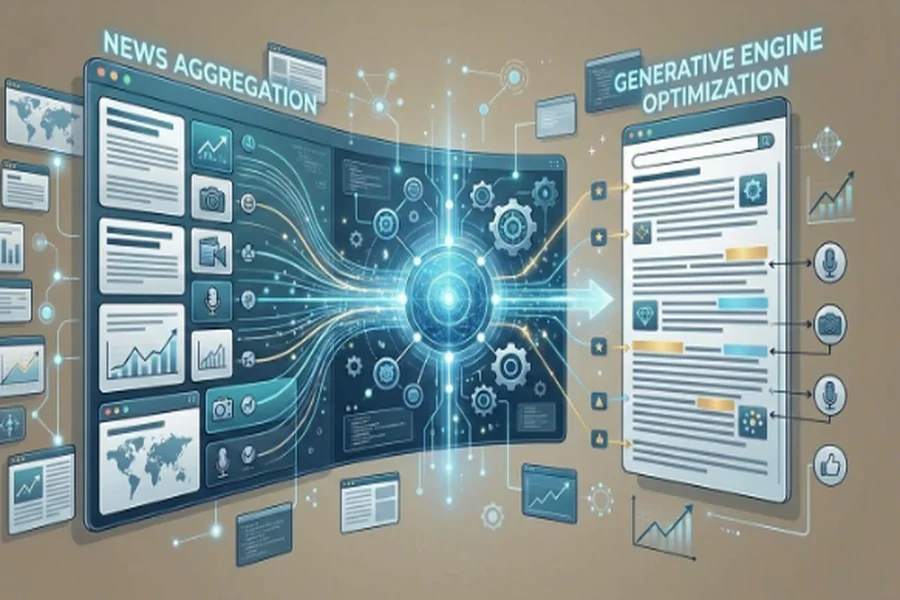
Geolocation or generative optimization is essential for every business today, as it helps them understand what information appears in search engines without limiting the data available on the Internet. This is why news aggregators matter: they help companies access the information they need about their business, competitors, and other aspects important to their operations.
How is GEO Connected with News?
Generative search systems can utilize information from different sources and bring the data together to create a response. Thus, the type of information a company can attract depends on several factors. Because generative search relies on information retrieval, it is important to focus on the information environment. Thus, clients and generative systems can find a company through other channels.
For example, a software company may notice that several publications are discussing data security while competitors are increasingly mentioned in relation to a specific solution. This can reveal which subjects are gaining attention and where the company’s visibility may be limited.
It is important to comprehend the entire space of the brand’s marketplace before going down the path of maximizing the essential obligations of attaining all that can be done by following the GEO procedures as closely as possible, using current and relevant information in AI searches.
Data must be fresh when addressing dynamic situations (e.g., product releases, legislative changes, commercial opportunities, etc.).
Google has made progress with AI by correlating its own information with useful information from websites, etc. It is therefore critical for businesses to follow fresh information and avoid relying on older, out-of-date content.
Tracking trending issues in your subject matter gives the company an edge in addressing client inquiries. A business can bring any new information into practice by either revamping its old content or publishing new content before the subject becomes too complex and competitive.
The Value of News Aggregation in GEO Analysis
News aggregation is only valuable if it is properly organized, not merely a collection of news headlines.
A GEO-focused monitoring process can cover:
- Industry news
- Competitor announcements
- Product launches
- Expert commentary
- Customer concerns
- Regulatory developments
- Reviews and comparisons
- Emerging industry topics
Businesses can search for recurrent topics after gathering this data. Customers may soon ask AI systems how various businesses compare in that area if multiple publications start talking about a new technology. Early awareness lets a brand provide precise, helpful answers to those queries.
News analysis can also reveal visibility gaps. If competitors are repeatedly discussed in relation to a topic while a company has little relevant information available, the difference may indicate an opportunity.
Research from GEO has again highlighted the critical need for outside resources to substantiate information provided by AI. According to a search-generation report about such sources, properly vetted third-party provider/owner sources are necessary to make AI-generated information reliable. This shows that it is imperative to identify how the company is represented on the Internet other than its own website.
Nevertheless, companies should not rely on simple mention frequency. The type of information obtained is far more significant than any other individual mention that does not provide meaningful context.
The GEOAgent collects current news for GEO insights. When monitoring news and GEO calls for using GEO and news together to decide which questions to examine first, it’s essential to decide which brand, industry, competitor, or topic you will be monitoring. Pay attention to monitoring queries that your prospective clients may enter into an AI system in the first place.
A company selling project management software, for instance, can monitor themes such as software updates, team productivity and teamwork, as well as remote working.
Using GEOAgent for News Analysis
To begin with, we need to find out which topics are related to the business, including what type of company it is, its offerings, rivals, customer problems, and recent happenings in the industry.
Now that we’ve discovered relevant news and articles about our topics, we need to search for those subjects that repeat, rather than those that are just seen a couple of times. If a certain topic has appeared many times across different well-known outlets, then it likely means it’s a trend in the industry.
Once we’ve identified our topics, we can come up with Artificial Intelligence (AI) queries based on these topics. Queries can involve facts, comparisons, recommendations, and solutions.
Run the questions through the GEOAgent analysis workflow. Review whether the brand appears in the answers and how it compares with competitors.
Be aware of what sources you rely on in conducting your investigation. If competition is constantly being mentioned in reputable industry journals and the brand has limited presence in such materials, this could demonstrate a visibility gap for the brand.
Take note of the information gathered during your research and conduct this type of assessment in the future. AI-generated search results vary based on the search terms used, the platform on which it is done, what is on the web at that time, etc. Therefore, performing the same search will help identify trends in the brand’s visibility.
What to Look for in the Results
First, determine whether the brand appears at all. Then examine how it appears.
A brand may receive a brief mention, appear as a recommendation, or be supported by a citation. These represent different forms of visibility and should be evaluated separately.
Competitor visibility is an important part of competitive benchmarking. If your competition consistently shows up for keyword queries associated with specific events that are emerging in your industry, pay attention to this occurrence. Your competition may be doing well in content quality, volume of third-party references, branding, or alignment with the keywords in question.
Keep these incidents in mind when you see news reports. If you see an increase in the number of articles relevant to a certain topic, but you do not find any visibility of your company on the subject. You can provide new information or refresh existing articles.
Creating GEO Strategies Based on News Intelligence
Always remember that news aggregation should never replace good content creation. It was developed to give you more information in order to make decisions.
Your company can use news analytics to create better content when it comes to existing and outdated information.
The practical lesson is that brands should pay attention to both what they publish and what the wider industry is saying about their subject.
Conclusion
GEO has a very strong association with News Aggregation owing to the fact that they both help businesses understand what is happening around them in their industry. News aggregation is responsible for showing users the current media perceptions, trending stories, and prevailing opinions about rival companies. However, not only is this one of its benefits, but it also shows how artificial intelligence allows users to communicate with several other brands.
With the GEOAgent, companies can now obtain continuous benefits from this process. They are able to ask relevant questions, determine what a brand’s media representation looks like, and monitor its behavior.